
Introduction
Semantic Search Platforms help AI systems understand the meaning, context, and intent behind search queries instead of relying only on exact keyword matching. These platforms use embeddings, vector search, natural language processing, retrieval models, and ranking systems to deliver more relevant results across documents, websites, enterprise knowledge bases, code repositories, support systems, and AI applications.
Semantic search has become one of the most important foundations of modern AI systems because retrieval quality directly impacts answer quality in AI copilots, retrieval augmented generation systems, AI agents, enterprise search, recommendation systems, and conversational assistants. Organizations now need search systems that understand relationships, user intent, synonyms, context, and semantic similarity at scale.
Why It Matters
- Improves AI answer relevance
- Reduces hallucination in retrieval augmented generation
- Enhances enterprise knowledge discovery
- Supports AI copilots and AI agents
- Improves multilingual and conversational search
- Enables context-aware search experiences
Real-World Use Cases
- Enterprise document retrieval
- AI-powered customer support
- Ecommerce semantic product search
- Internal knowledge assistants
- Developer code search
- Legal and compliance document retrieval
- Healthcare research search
- AI-powered recommendation systems
Evaluation Criteria for Buyers
- Hybrid keyword and semantic retrieval
- Embedding and vector search support
- Retrieval quality and ranking accuracy
- Scalability and indexing speed
- Security and governance controls
- Observability and analytics
- Real-time indexing capabilities
- Integration ecosystem
- Deployment flexibility
- Cost efficiency at scale
- Multilingual support
- Vendor lock in risk
Best for: AI platform teams, enterprise search teams, ML engineers, SaaS companies, customer support platforms, ecommerce companies, and organizations building AI retrieval systems.
Not ideal for: Small websites with simple keyword search needs, static datasets, or teams without AI infrastructure requirements.
What’s Changed in Semantic Search Platforms
- Hybrid keyword and semantic retrieval is now standard architecture
- AI agents are increasing demand for contextual retrieval
- Multimodal search is expanding beyond text retrieval
- Retrieval evaluation is becoming critical for production AI
- AI observability and tracing are now major requirements
- Real-time indexing is replacing slower ingestion workflows
- Governance and enterprise security expectations are rising
- Embedding optimization is becoming more important for cost control
- Semantic reranking is improving retrieval precision
- AI copilots are driving enterprise semantic search adoption
- Vector databases are becoming tightly integrated with search systems
- Enterprises increasingly demand permission-aware retrieval systems
Quick Buyer Checklist
- Does the platform support hybrid search
- Can it scale to large enterprise datasets
- Does it support retrieval augmented generation workflows
- Can it integrate with vector databases
- Does it support metadata filtering
- Are observability and tracing available
- Does it support multilingual retrieval
- Are RBAC and audit controls available
- Does it support real-time indexing
- Does pricing remain manageable at scale
- Does it integrate with your AI stack
- Can you migrate data easily if needed
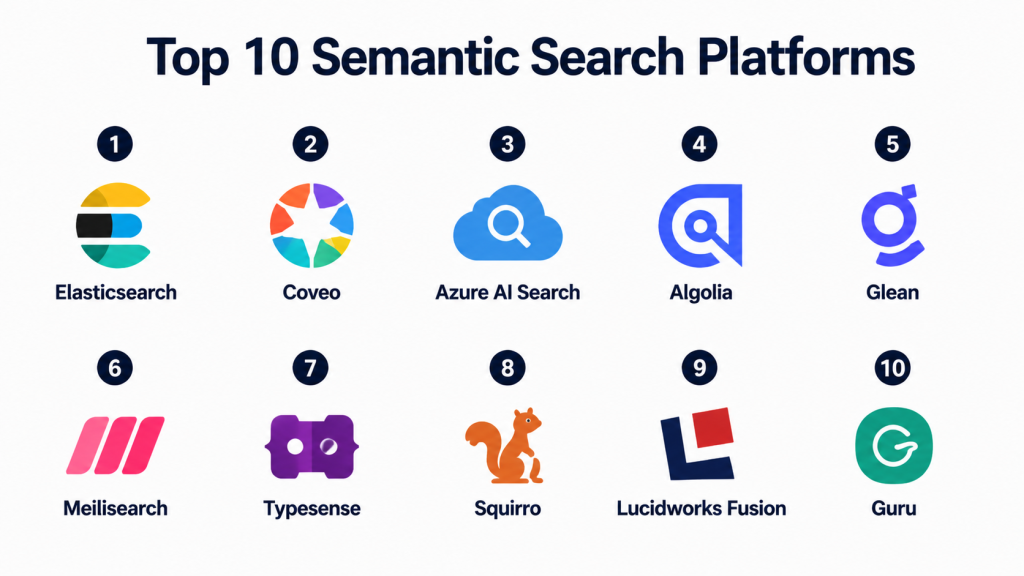
Top 10 Semantic Search Platforms
1- Elasticsearch
One-line verdict: Best for enterprises needing mature hybrid search with strong operational tooling.
Short description:
Elasticsearch is one of the most widely adopted enterprise search platforms and now includes semantic and vector search capabilities alongside traditional keyword retrieval.
It is heavily used in enterprise search, analytics, observability, and AI retrieval systems.
The platform is especially strong for hybrid search use cases combining structured filters, keyword relevance, and semantic ranking.
It works well for large enterprises needing operational maturity and scalability.
Standout Capabilities
- Hybrid keyword and semantic search
- Distributed indexing architecture
- Vector search support
- Advanced filtering and aggregations
- Mature analytics ecosystem
- Large plugin ecosystem
- Enterprise observability integrations
- Scalable infrastructure
AI-Specific Depth
- Model support: External embeddings and vector integrations
- RAG and knowledge integration: Strong support through APIs and frameworks
- Evaluation: Limited native retrieval evaluation
- Guardrails: Enterprise controls vary by deployment
- Observability: Strong analytics and monitoring ecosystem
Pros
- Mature enterprise platform
- Excellent hybrid retrieval
- Strong operational tooling
Cons
- Can be operationally complex
- Resource intensive at scale
- May require specialist expertise
Security and Compliance
RBAC, encryption, SSO, audit logging, and enterprise security features are available depending on deployment and subscription level. Certifications and residency controls vary.
Deployment and Platforms
- Cloud
- Self hosted
- Kubernetes
- Linux infrastructure
- Web management interface
Integrations and Ecosystem
- Kibana
- Logstash
- Vector databases
- AI orchestration frameworks
- Observability systems
- Enterprise data pipelines
Pricing Model
Subscription and usage based pricing depending on deployment and enterprise features.
Best-Fit Scenarios
- Enterprise semantic search
- Hybrid retrieval systems
- AI observability linked search
- Knowledge retrieval systems
- Large-scale enterprise search
2- Coveo
One-line verdict: Best for AI-powered enterprise relevance and personalized search experiences.
Short description:
Coveo is an AI-powered semantic search and relevance platform designed for enterprise search, customer support, and ecommerce experiences.
It focuses heavily on personalized and context-aware retrieval.
The platform is commonly used in customer support, commerce, and enterprise knowledge systems.
It is especially strong for relevance optimization and AI-driven ranking workflows.
Standout Capabilities
- AI-powered relevance optimization
- Personalized semantic search
- Hybrid retrieval architecture
- Real-time indexing
- Enterprise integrations
- Context-aware recommendations
- Search analytics
- AI ranking workflows
AI-Specific Depth
- Model support: Managed AI relevance workflows
- RAG and knowledge integration: Strong enterprise retrieval support
- Evaluation: Relevance analytics available
- Guardrails: Enterprise governance varies by plan
- Observability: Search analytics and monitoring support
Pros
- Strong enterprise search relevance
- Excellent personalization capabilities
- Good customer support integrations
Cons
- Enterprise pricing complexity
- Less developer flexibility than open source tools
- Advanced configuration may require support teams
Security and Compliance
Enterprise access controls, governance, and security integrations are available depending on deployment and plan.
Deployment and Platforms
- Cloud deployment
- Enterprise SaaS workflows
- API integrations
- Enterprise application integrations
Integrations and Ecosystem
- Salesforce
- SAP
- Adobe
- Service platforms
- Enterprise content systems
- AI workflows
Pricing Model
Enterprise subscription pricing based on deployment scale and features.
Best-Fit Scenarios
- Enterprise knowledge search
- Customer support retrieval
- Ecommerce semantic search
- Personalized AI search
- Large customer experience platforms
3- Azure AI Search
One-line verdict: Best for enterprises standardizing semantic search within Microsoft cloud ecosystems.
Short description:
Azure AI Search combines semantic retrieval, vector search, indexing, and AI enrichment capabilities inside Microsoft cloud infrastructure.
It is designed for enterprise AI applications requiring governance, scalability, and cloud-native deployment.
The platform supports retrieval augmented generation and AI-powered enterprise search workflows.
It is widely adopted by enterprises already invested in Microsoft cloud ecosystems.
Standout Capabilities
- Semantic and vector search support
- AI enrichment pipelines
- Enterprise governance integration
- Cloud-native scalability
- Hybrid retrieval support
- AI-powered indexing
- Microsoft ecosystem integration
- Enterprise access controls
AI-Specific Depth
- Model support: Managed and partner embedding models
- RAG and knowledge integration: Strong Azure AI compatibility
- Evaluation: Limited native evaluation tooling
- Guardrails: Governance controls available
- Observability: Azure monitoring integrations
Pros
- Strong Microsoft ecosystem fit
- Enterprise governance capabilities
- Scalable AI retrieval workflows
Cons
- Azure dependency
- Complex enterprise configuration
- Vendor lock in considerations
Security and Compliance
Azure IAM, encryption, governance, audit logging, and enterprise cloud security capabilities are available depending on deployment.
Deployment and Platforms
- Cloud deployment
- Azure managed infrastructure
- Enterprise cloud workflows
- API access
Integrations and Ecosystem
- Azure ecosystem
- Microsoft AI services
- Enterprise applications
- AI orchestration frameworks
- Retrieval workflows
Pricing Model
Cloud usage pricing based on indexing, storage, and query volume.
Best-Fit Scenarios
- Enterprise AI search
- Microsoft ecosystem deployments
- Retrieval augmented generation
- Governed semantic retrieval
- Enterprise copilots
4- Algolia
One-line verdict: Best for fast AI-enhanced search experiences in ecommerce and SaaS products.
Short description:
Algolia is a search platform focused on fast search experiences, AI relevance, and developer-friendly APIs.
It is popular in ecommerce, SaaS, and customer-facing applications needing responsive semantic retrieval.
The platform combines keyword search, AI ranking, personalization, and semantic search capabilities.
It is useful for teams prioritizing search speed and user experience.
Standout Capabilities
- Fast search performance
- AI ranking support
- Ecommerce search optimization
- Personalization workflows
- API-first architecture
- Search analytics
- Relevance tuning
- Developer-friendly setup
AI-Specific Depth
- Model support: AI ranking and semantic workflows vary by product tier
- RAG and knowledge integration: Limited compared with enterprise AI search platforms
- Evaluation: Search analytics available
- Guardrails: Varies / N/A
- Observability: Search performance metrics available
Pros
- Excellent speed
- Strong ecommerce fit
- Easy developer onboarding
Cons
- Enterprise AI workflows less mature
- Advanced governance depth varies
- Complex pricing at scale
Security and Compliance
Enterprise access controls and cloud security features vary depending on plan and deployment.
Deployment and Platforms
- Cloud deployment
- SaaS workflows
- API access
- Web management interface
Integrations and Ecosystem
- Ecommerce platforms
- SaaS applications
- AI search workflows
- APIs and frontend systems
- Analytics integrations
Pricing Model
Usage and subscription-based pricing depending on query volume and features.
Best-Fit Scenarios
- Ecommerce semantic search
- SaaS product search
- Customer-facing search systems
- Fast AI-enhanced search experiences
- Personalized search workflows
5- Glean
One-line verdict: Best for enterprise workplace search across internal company systems.
Short description:
Glean is an enterprise AI search platform focused on permission-aware workplace retrieval.
It helps employees search across internal tools, documents, tickets, chats, and company knowledge.
The platform emphasizes enterprise productivity and contextual retrieval.
It works well for internal enterprise knowledge discovery.
Standout Capabilities
- Enterprise workplace search
- Permission-aware retrieval
- AI-powered knowledge discovery
- Cross-platform indexing
- Enterprise productivity focus
- Contextual ranking
- AI assistant workflows
- Unified enterprise retrieval
AI-Specific Depth
- Model support: Managed AI retrieval workflows
- RAG and knowledge integration: Strong enterprise retrieval support
- Evaluation: Search analytics available
- Guardrails: Enterprise access controls supported
- Observability: Monitoring and analytics available
Pros
- Strong workplace retrieval
- Good enterprise integrations
- Permission-aware indexing
Cons
- Enterprise focused pricing
- Less developer flexibility
- Best suited for internal search use cases
Security and Compliance
Enterprise access controls, permissions, and governance capabilities are core platform features. Certifications and compliance vary by deployment.
Deployment and Platforms
- Cloud deployment
- Enterprise SaaS workflows
- Web interfaces
- API integrations
Integrations and Ecosystem
- Slack
- Google Workspace
- Jira
- Confluence
- Microsoft ecosystems
- Enterprise applications
Pricing Model
Enterprise subscription pricing.
Best-Fit Scenarios
- Enterprise workplace search
- Internal knowledge assistants
- Employee productivity systems
- Company-wide retrieval platforms
- Enterprise AI copilots
6- Meilisearch
One-line verdict: Best for lightweight semantic search with strong developer simplicity.
Short description:
Meilisearch is a developer-friendly search platform designed for fast and simple search experiences.
It supports AI-enhanced retrieval and semantic workflows for modern applications.
The platform is popular with startups and developer teams needing lightweight search infrastructure.
It works well for fast deployment and API-first architectures.
Standout Capabilities
- Lightweight search engine
- Fast indexing
- Developer-friendly APIs
- Semantic search support
- Easy deployment workflows
- Open source ecosystem
- Fast query performance
- Simple configuration
AI-Specific Depth
- Model support: External embeddings and vector integrations
- RAG and knowledge integration: Supported through frameworks
- Evaluation: Varies / N/A
- Guardrails: Varies / N/A
- Observability: Basic metrics and analytics available
Pros
- Simple setup
- Fast search experience
- Good developer usability
Cons
- Enterprise governance depth varies
- Large-scale retrieval may need tuning
- Smaller enterprise ecosystem
Security and Compliance
Security controls depend on deployment architecture and infrastructure provider.
Deployment and Platforms
- Cloud deployment
- Self hosted
- API access
- Linux infrastructure
- Web management support varies
Integrations and Ecosystem
- APIs
- AI frameworks
- SaaS applications
- Developer tooling
- Vector workflows
Pricing Model
Open source with managed hosting and enterprise options.
Best-Fit Scenarios
- Startup semantic search
- Lightweight AI retrieval
- SaaS application search
- Developer-first search infrastructure
- Fast deployment workflows
7- Typesense
One-line verdict: Best for fast open source semantic search with simple operational workflows.
Short description:
Typesense is an open source search engine designed for developer-friendly semantic and typo-tolerant search.
It focuses on speed, usability, and simple deployment patterns.
The platform supports vector search and semantic retrieval capabilities for AI-enhanced applications.
It works well for startups and teams wanting lightweight search infrastructure.
Standout Capabilities
- Fast search performance
- Typo tolerance
- Vector search support
- Lightweight architecture
- Developer-friendly APIs
- Open source deployment
- Easy operational workflows
- Fast indexing support
AI-Specific Depth
- Model support: External embeddings and vector integrations
- RAG and knowledge integration: Supported through frameworks
- Evaluation: Varies / N/A
- Guardrails: Varies / N/A
- Observability: Basic monitoring available
Pros
- Easy deployment
- Fast retrieval
- Strong developer experience
Cons
- Enterprise tooling less mature
- Smaller ecosystem
- Advanced governance features limited
Security and Compliance
Security depends on deployment architecture and infrastructure setup.
Deployment and Platforms
- Self hosted
- Cloud hosting
- Linux infrastructure
- API access
- Container support
Integrations and Ecosystem
- AI frameworks
- APIs
- SaaS applications
- Vector workflows
- Open source search systems
Pricing Model
Open source with managed cloud offerings.
Best-Fit Scenarios
- Startup AI search
- Lightweight semantic retrieval
- SaaS application search
- Open source search deployments
- Fast API-driven search systems
8- Squirro
One-line verdict: Best for enterprise knowledge intelligence and contextual semantic search.
Short description:
Squirro is an enterprise semantic search and insight platform focused on contextual intelligence and enterprise knowledge retrieval.
It combines AI search, analytics, and insight extraction workflows.
The platform is used in finance, operations, and enterprise knowledge systems.
It works well for organizations needing contextual retrieval and analytics.
Standout Capabilities
- Enterprise semantic search
- Contextual knowledge retrieval
- AI-driven insights
- Enterprise analytics workflows
- Knowledge intelligence
- AI ranking systems
- Enterprise integrations
- Context-aware retrieval
AI-Specific Depth
- Model support: Managed AI workflows
- RAG and knowledge integration: Enterprise retrieval support
- Evaluation: Analytics support available
- Guardrails: Enterprise governance varies
- Observability: Enterprise monitoring capabilities available
Pros
- Strong enterprise focus
- Good analytics integration
- Useful contextual retrieval workflows
Cons
- Enterprise pricing complexity
- Smaller developer ecosystem
- Advanced onboarding requirements
Security and Compliance
Enterprise governance and access controls vary depending on deployment and industry requirements.
Deployment and Platforms
- Cloud deployment
- Enterprise infrastructure
- API workflows
- Enterprise integrations
Integrations and Ecosystem
- Enterprise systems
- AI analytics workflows
- Knowledge platforms
- Search systems
- Enterprise data pipelines
Pricing Model
Enterprise subscription pricing.
Best-Fit Scenarios
- Enterprise knowledge intelligence
- Financial document retrieval
- AI-driven enterprise search
- Contextual retrieval systems
- Enterprise analytics search
9- Lucidworks Fusion
One-line verdict: Best for enterprise-grade AI-powered search and relevance optimization.
Short description:
Lucidworks Fusion is an enterprise search platform built around AI-powered relevance, semantic retrieval, and search optimization.
It is commonly used for customer support, ecommerce, and enterprise search systems.
The platform focuses heavily on relevance tuning and AI-enhanced retrieval quality.
It fits organizations needing advanced search optimization workflows.
Standout Capabilities
- AI-powered relevance optimization
- Enterprise semantic retrieval
- Search analytics
- Hybrid search support
- Enterprise integrations
- Search tuning workflows
- AI ranking systems
- Customer support search
AI-Specific Depth
- Model support: AI relevance workflows vary by deployment
- RAG and knowledge integration: Enterprise retrieval compatibility
- Evaluation: Search analytics and optimization workflows
- Guardrails: Enterprise governance varies
- Observability: Search monitoring available
Pros
- Strong enterprise search focus
- Good relevance optimization
- Mature search workflows
Cons
- Enterprise complexity
- Advanced onboarding requirements
- Pricing may be high for smaller teams
Security and Compliance
Enterprise governance, RBAC, encryption, and security workflows vary by deployment.
Deployment and Platforms
- Cloud deployment
- Self hosted enterprise workflows
- API access
- Enterprise integrations
Integrations and Ecosystem
- Enterprise content systems
- AI search workflows
- Ecommerce systems
- Support platforms
- Enterprise data pipelines
Pricing Model
Enterprise pricing depending on deployment scale and feature requirements.
Best-Fit Scenarios
- Enterprise semantic search
- Ecommerce retrieval
- Customer support search
- Relevance optimization
- Enterprise AI retrieval
10- Guru
One-line verdict: Best for AI-powered workplace knowledge retrieval with verification workflows.
Short description:
Guru is an enterprise knowledge management and semantic search platform focused on verified workplace information retrieval.
It combines AI-powered search with internal documentation and collaboration workflows.
The platform is commonly used for employee enablement and internal knowledge systems.
It works well for organizations wanting trusted workplace AI retrieval.
Standout Capabilities
- Verified knowledge retrieval
- Workplace AI search
- Enterprise documentation workflows
- AI-powered recommendations
- Contextual retrieval
- Employee enablement support
- Internal knowledge systems
- Search and collaboration integration
AI-Specific Depth
- Model support: Managed AI workflows
- RAG and knowledge integration: Enterprise retrieval support
- Evaluation: Analytics support varies
- Guardrails: Permission-aware retrieval available
- Observability: Usage analytics available
Pros
- Good workplace knowledge management
- Trusted retrieval workflows
- Strong employee enablement fit
Cons
- Less flexible for developer-heavy AI systems
- Enterprise pricing structure
- Limited customization compared with open source systems
Security and Compliance
Enterprise permissions, governance, and access controls vary by deployment and plan.
Deployment and Platforms
- Cloud deployment
- Enterprise SaaS workflows
- Web interfaces
- API integrations
Integrations and Ecosystem
- Slack
- Enterprise collaboration tools
- Documentation systems
- Workplace knowledge platforms
- Enterprise workflows
Pricing Model
Subscription-based enterprise pricing.
Best-Fit Scenarios
- Internal knowledge retrieval
- Employee enablement
- AI-powered documentation search
- Workplace semantic search
- Enterprise collaboration systems
Comparison Table
| Tool | Best For | Deployment | Key Strength | Pricing Model | Ideal Buyer |
|---|---|---|---|---|---|
| Elasticsearch | Enterprise hybrid search | Cloud and self hosted | Mature ecosystem | Subscription and usage based | Enterprise search teams |
| Coveo | Personalized AI search | Cloud | AI relevance | Enterprise subscription | Large enterprises |
| Azure AI Search | Microsoft AI search | Cloud | Enterprise governance | Cloud usage pricing | Microsoft ecosystem teams |
| Algolia | Fast SaaS and ecommerce search | Cloud | Speed and UX | Usage based | SaaS and ecommerce teams |
| Glean | Workplace search | Cloud | Permission-aware retrieval | Enterprise subscription | Enterprise knowledge teams |
| Meilisearch | Lightweight semantic search | Cloud and self hosted | Developer simplicity | Open source plus managed | Startups |
| Typesense | Open source AI search | Cloud and self hosted | Fast API search | Open source plus managed | Developers |
| Squirro | Knowledge intelligence | Cloud | Contextual analytics | Enterprise pricing | Enterprise analytics teams |
| Lucidworks Fusion | Relevance optimization | Cloud and self hosted | AI-powered search tuning | Enterprise pricing | Enterprise AI search teams |
| Guru | Workplace AI retrieval | Cloud | Verified knowledge workflows | Subscription pricing | Internal knowledge teams |
Scoring and Evaluation Table
| Tool | Core Search | Ease of Use | Scalability | AI Integration | Security Readiness | Observability | Value | Weighted Total |
|---|---|---|---|---|---|---|---|---|
| Elasticsearch | 9 | 6 | 9 | 8 | 8 | 9 | 7 | 8.2 |
| Coveo | 8 | 7 | 8 | 8 | 8 | 8 | 7 | 7.7 |
| Azure AI Search | 8 | 7 | 9 | 8 | 9 | 8 | 7 | 8.0 |
| Algolia | 8 | 9 | 8 | 7 | 7 | 7 | 8 | 7.7 |
| Glean | 8 | 8 | 8 | 8 | 9 | 7 | 7 | 7.9 |
| Meilisearch | 7 | 9 | 7 | 7 | 6 | 6 | 9 | 7.3 |
| Typesense | 7 | 8 | 7 | 7 | 6 | 6 | 8 | 7.0 |
| Squirro | 8 | 6 | 8 | 8 | 8 | 8 | 7 | 7.6 |
| Lucidworks Fusion | 8 | 6 | 8 | 8 | 8 | 8 | 7 | 7.6 |
| Guru | 7 | 8 | 7 | 7 | 8 | 7 | 8 | 7.4 |
Top 3 Tools for Enterprise
1- Elasticsearch
Best for enterprises needing mature hybrid search, observability, and scalable AI retrieval infrastructure.
2- Azure AI Search
Best for organizations standardizing semantic search and AI retrieval inside Microsoft cloud environments.
3- Coveo
Best for enterprises prioritizing AI relevance, personalization, and customer experience search.
Top 3 Tools for SMB
1- Algolia
Best for SMB teams needing fast and user-friendly semantic search experiences.
2- Meilisearch
Best for startups wanting lightweight AI search with easy deployment workflows.
3- Typesense
Best for smaller teams wanting open source semantic search with strong developer usability.
Top 3 Tools for Developers
1- Meilisearch
Best for developers wanting lightweight semantic search with simple APIs.
2- Typesense
Best for developers building fast AI-enhanced search systems.
3- Elasticsearch
Best for developers needing advanced hybrid search and operational flexibility.
Which Tool Is Right for You
For enterprise hybrid search
Choose Elasticsearch when you need mature keyword search, vector retrieval, observability, and large-scale enterprise operations.
For personalized AI retrieval
Choose Coveo when relevance optimization and contextual ranking are core business requirements.
For Microsoft cloud ecosystems
Choose Azure AI Search if your organization already depends heavily on Azure infrastructure and governance workflows.
For ecommerce and SaaS search
Choose Algolia when speed, user experience, and AI-powered search relevance matter most.
For workplace knowledge retrieval
Choose Glean or Guru when internal company knowledge search and employee productivity are primary goals.
For open source flexibility
Choose Meilisearch or Typesense if you want lightweight search infrastructure with developer-friendly APIs.
For enterprise knowledge intelligence
Choose Squirro or Lucidworks Fusion when contextual analytics and enterprise relevance optimization are priorities.
Implementation Playbook
First 30 Days
- Define semantic search use cases
- Identify core data sources
- Benchmark keyword versus semantic retrieval quality
- Test embedding models and ranking quality
- Pilot three search platforms
- Measure retrieval relevance and latency
- Build a small semantic indexing workflow
Next 60 Days
- Add hybrid retrieval workflows
- Improve metadata filtering
- Connect retrieval systems to AI applications
- Build observability dashboards
- Implement governance and access controls
- Evaluate multilingual search quality
- Test production query patterns
Next 90 Days
- Scale indexing for production workloads
- Add reranking workflows
- Optimize latency and retrieval cost
- Build evaluation pipelines
- Finalize security and governance policies
- Create reindexing and backup workflows
- Validate retrieval quality with live users
Common Mistakes and How to Avoid Them
1- Using only vector search
Pure semantic retrieval can miss exact terms, IDs, legal phrases, and product codes. Hybrid retrieval improves accuracy.
2- Ignoring metadata filtering
Metadata filtering improves precision and permission-aware retrieval.
3- Underestimating observability
Teams need query analytics, latency metrics, and retrieval tracing to optimize production search.
4- Choosing platforms only by popularity
A popular search platform may not match your deployment, governance, or scalability requirements.
5- Ignoring retrieval evaluation
Without evaluation datasets and relevance testing, teams cannot measure search quality improvements.
6- Weak chunking strategies
Poor chunking creates retrieval quality issues in retrieval augmented generation workflows.
7- Skipping governance controls
Semantic retrieval can expose sensitive business data without proper RBAC and access filtering.
8- Ignoring cost optimization
Large-scale indexing and vector retrieval can become expensive without efficient caching and infrastructure planning.
9- Treating frameworks like databases
Search orchestration frameworks still require strong indexing and retrieval backends.
10- Not planning migration workflows
Vendor lock in becomes difficult to manage without export and migration planning.
Frequently Asked Questions
1- What is a Semantic Search Platform?
A Semantic Search Platform helps users retrieve information based on meaning, context, and intent instead of exact keyword matching.
2- Why is semantic search important for AI systems?
Semantic search improves retrieval quality, reduces hallucination, and helps AI systems access relevant context before generating responses.
3- What is hybrid search?
Hybrid search combines keyword search and semantic vector retrieval to improve search accuracy and relevance.
4- Which platform is best for enterprise search?
Elasticsearch, Azure AI Search, and Coveo are strong enterprise semantic search options depending on infrastructure and governance needs.
5- Which platform is best for startups?
Meilisearch, Typesense, and Algolia are popular because they simplify deployment and reduce operational complexity.
6- How does semantic search support retrieval augmented generation?
Semantic search retrieves contextually relevant documents and data before a language model generates a response.
7- What role do embeddings play in semantic search?
Embeddings convert content into vector representations that capture semantic meaning and similarity relationships.
8- Why is observability important in semantic retrieval systems?
Observability helps teams monitor latency, retrieval quality, query failures, and operational cost in production environments.
9- What is the biggest challenge in semantic search systems?
Balancing retrieval accuracy, latency, scalability, governance, and cost is usually the biggest production challenge.
10- How should teams evaluate semantic search quality?
Teams should benchmark retrieval relevance, answer quality, latency, multilingual performance, and real user query accuracy using production-style datasets.
Conclusion
Semantic Search Platforms are becoming one of the most important infrastructure layers in modern AI systems. They help organizations retrieve meaningful context, improve retrieval augmented generation quality, support enterprise knowledge discovery, and enable smarter AI copilots and agents. As AI applications become increasingly retrieval-driven, semantic search quality directly impacts business productivity, customer experience, and AI reliability.The best platform depends on your deployment strategy, governance requirements, engineering maturity, retrieval complexity, and infrastructure ecosystem. Elasticsearch remains a leading choice for enterprise hybrid retrieval, while Coveo and Azure AI Search are strong for enterprise AI workflows. Algolia, Meilisearch, and Typesense provide simpler developer-focused search experiences, while Glean and Guru focus heavily on workplace knowledge retrieval. The best next step is to shortlist three platforms, benchmark retrieval quality using real datasets and user queries, validate observability and governance capabilities, then scale gradually with strong evaluation and monitoring practices.

Find Trusted Cardiac Hospitals
Compare heart hospitals by city and services — all in one place.
Explore Hospitals