
Introduction
Pharmaceutical supply chains are among the most regulated and risk-sensitive ecosystems in the world. From raw material sourcing and manufacturing to distribution, storage, and last-mile delivery, every step must comply with strict global and local regulations. Pharmaceutical Supply Chain Compliance Tools are specialized software platforms designed to ensure traceability, data integrity, regulatory adherence, and risk mitigation across this complex network.
These tools help organizations comply with regulations such as drug serialization mandates, good distribution practices (GDP), good manufacturing practices (GMP), cold-chain requirements, and anti-counterfeiting laws. Beyond compliance, they play a critical role in protecting patient safety, reducing recalls, and maintaining brand trust.
Common real-world use cases include end-to-end drug traceability, serialization reporting, supplier compliance management, audit readiness, temperature monitoring, and recall management. When choosing a tool, buyers should evaluate regulatory coverage, scalability, integration with ERP/WMS systems, data security, audit capabilities, and ease of use, as these factors directly affect compliance outcomes and operational efficiency.
Best for:
Pharmaceutical manufacturers, biotech companies, contract manufacturing organizations (CMOs), distributors, wholesalers, and large hospital supply chains that operate in regulated markets or across multiple countries.
Not ideal for:
Small, non-regulated businesses or early-stage startups without serialization, cold-chain, or regulatory reporting requirements, where lightweight inventory or logistics tools may be sufficient.
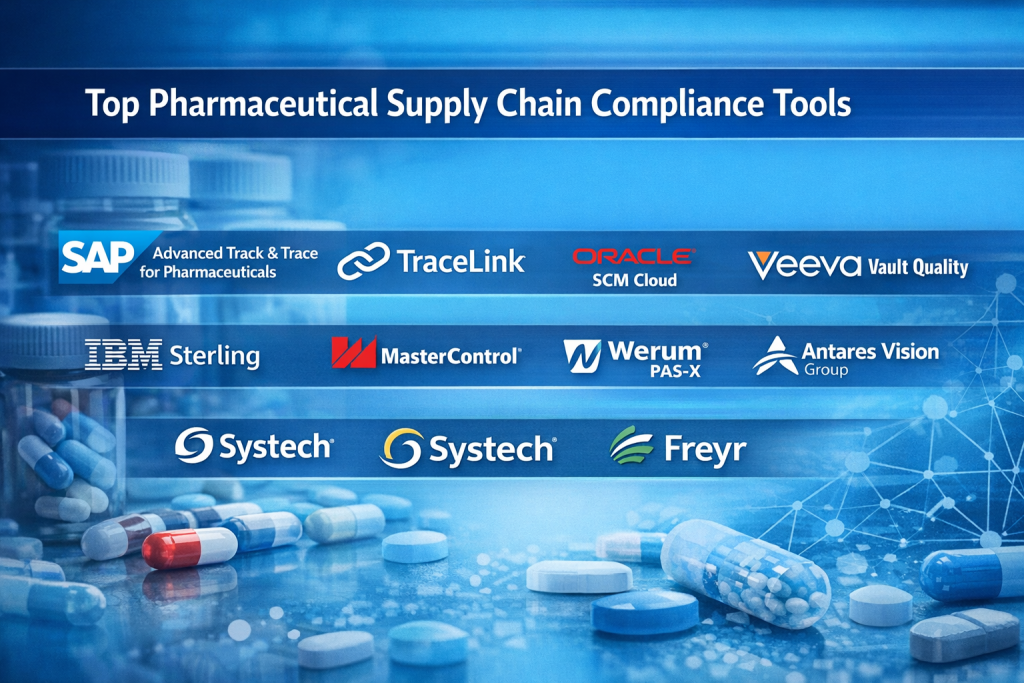
Top 10 Pharmaceutical Supply Chain Compliance Tools
1 — SAP Advanced Track and Trace for Pharmaceuticals
Short description:
An enterprise-grade compliance and serialization platform designed for global pharmaceutical manufacturers operating under complex regulatory environments.
Key features:
- End-to-end serialization and aggregation
- Global regulatory reporting support
- Real-time track-and-trace visibility
- Integration with SAP ERP and SCM modules
- Recall and exception management
- Audit-ready compliance reporting
Pros:
- Highly scalable for multinational operations
- Strong regulatory depth and accuracy
Cons:
- High implementation and licensing cost
- Requires SAP ecosystem expertise
Security & compliance:
SSO, encryption, audit logs, GDPR, ISO standards support
Support & community:
Extensive enterprise documentation, certified partners, premium SAP support
2 — TraceLink
Short description:
A cloud-based digital network connecting pharmaceutical manufacturers, CMOs, distributors, and regulators.
Key features:
- Global drug serialization and verification
- Partner connectivity network
- Compliance reporting automation
- Recall and exception workflows
- Master data synchronization
- Analytics and dashboards
Pros:
- Strong industry adoption
- Reduces partner integration complexity
Cons:
- Subscription pricing may grow with scale
- Customization can be limited
Security & compliance:
SOC 2, GDPR, encryption, audit logs
Support & community:
Strong onboarding, active life sciences user community, enterprise support
3 — Oracle SCM Cloud
Short description:
A comprehensive cloud SCM suite with built-in compliance, traceability, and quality management for pharma enterprises.
Key features:
- Batch and lot traceability
- Quality and compliance management
- Supplier qualification tracking
- Regulatory reporting
- ERP and logistics integration
- Advanced analytics
Pros:
- Unified cloud platform
- Strong analytics and reporting
Cons:
- Complex implementation
- Requires Oracle ecosystem alignment
Security & compliance:
ISO, SOC, GDPR, enterprise security controls
Support & community:
Extensive documentation, global enterprise support
4 — Veeva Vault Quality
Short description:
A quality and compliance management platform built specifically for life sciences organizations.
Key features:
- Quality event and deviation management
- Audit and inspection readiness
- Document control and change management
- Supplier quality oversight
- Regulatory compliance workflows
- Cloud-native architecture
Pros:
- Designed exclusively for life sciences
- Strong regulatory credibility
Cons:
- Focused more on quality than logistics
- Premium pricing
Security & compliance:
GxP, GDPR, audit trails, role-based access
Support & community:
Excellent documentation, strong industry-focused support
5 — Antares Vision Group
Short description:
A specialized provider of track-and-trace and inspection solutions for pharmaceutical compliance.
Key features:
- Serialization and aggregation
- Packaging line integration
- Anti-counterfeiting measures
- Regulatory reporting
- Vision inspection systems
- Supply chain visibility
Pros:
- Deep specialization in pharma packaging
- Strong compliance accuracy
Cons:
- Hardware dependency in some setups
- Less flexible outside pharma
Security & compliance:
Encryption, audit logs, regulatory compliance support
Support & community:
Dedicated pharma experts, strong onboarding
6 — IBM Sterling Supply Chain
Short description:
An AI-enabled supply chain platform focused on visibility, compliance, and risk management.
Key features:
- End-to-end supply chain visibility
- AI-driven risk alerts
- Compliance and audit reporting
- Partner collaboration
- Integration with ERP systems
- Advanced analytics
Pros:
- Strong AI and analytics capabilities
- Suitable for complex global networks
Cons:
- Enterprise-focused pricing
- Requires configuration expertise
Security & compliance:
SOC, ISO, encryption, GDPR
Support & community:
Enterprise-grade support, extensive documentation
7 — MasterControl
Short description:
A quality and compliance management platform widely used in regulated life sciences environments.
Key features:
- Document and change control
- Training and certification tracking
- Audit management
- Supplier compliance
- CAPA workflows
- Regulatory readiness dashboards
Pros:
- Strong quality compliance focus
- Trusted by regulators
Cons:
- Limited logistics functionality
- Interface can feel complex
Security & compliance:
HIPAA, ISO, GDPR, audit logs
Support & community:
Strong customer support, training resources
8 — Werum PAS-X
Short description:
A manufacturing execution system (MES) optimized for pharmaceutical production and compliance.
Key features:
- GMP-compliant MES
- Batch record management
- Serialization integration
- Quality and deviation tracking
- Production traceability
- Regulatory documentation
Pros:
- Deep manufacturing compliance
- Strong regulatory acceptance
Cons:
- Manufacturing-centric focus
- High implementation effort
Security & compliance:
GMP, audit trails, role-based access
Support & community:
Enterprise support, strong pharma ecosystem
9 — Systech
Short description:
A digital traceability platform focusing on anti-counterfeiting and serialization.
Key features:
- End-to-end serialization
- Product authentication
- Compliance reporting
- Supply chain intelligence
- Packaging integration
- Recall support
Pros:
- Strong anti-counterfeit capabilities
- Global regulatory coverage
Cons:
- Narrower feature scope
- Best suited for serialization-heavy needs
Security & compliance:
Encryption, audit logs, regulatory compliance
Support & community:
Dedicated pharma support teams
10 — Freyr Solutions
Short description:
A regulatory intelligence and compliance management platform for life sciences companies.
Key features:
- Regulatory intelligence database
- Submission tracking
- Compliance monitoring
- Change impact analysis
- Document management
- Workflow automation
Pros:
- Strong regulatory insights
- Helpful for global compliance strategy
Cons:
- Limited operational logistics features
- Best as a complementary tool
Security & compliance:
GDPR, access controls, audit trails
Support & community:
Good documentation, responsive customer support
Comparison Table
| Tool Name | Best For | Platform(s) Supported | Standout Feature | Rating |
|---|---|---|---|---|
| SAP Advanced Track and Trace | Large global manufacturers | Cloud / On-prem | Deep global serialization | N/A |
| TraceLink | Network-based compliance | Cloud | Partner connectivity network | N/A |
| Oracle SCM Cloud | End-to-end SCM compliance | Cloud | Unified SCM platform | N/A |
| Veeva Vault Quality | Quality-focused compliance | Cloud | Life sciences specialization | N/A |
| Antares Vision Group | Packaging & traceability | Hybrid | Anti-counterfeiting | N/A |
| IBM Sterling | Risk & visibility management | Cloud | AI-driven insights | N/A |
| MasterControl | Quality management | Cloud | Audit readiness | N/A |
| Werum PAS-X | Manufacturing compliance | On-prem / Hybrid | GMP-compliant MES | N/A |
| Systech | Serialization & authentication | Hybrid | Product authentication | N/A |
| Freyr Solutions | Regulatory intelligence | Cloud | Regulatory intelligence | N/A |
Evaluation & Scoring of Pharmaceutical Supply Chain Compliance Tools
| Criteria | Weight | Average Score (1–5) |
|---|---|---|
| Core features | 25% | 4.6 |
| Ease of use | 15% | 3.9 |
| Integrations & ecosystem | 15% | 4.4 |
| Security & compliance | 10% | 4.7 |
| Performance & reliability | 10% | 4.5 |
| Support & community | 10% | 4.3 |
| Price / value | 15% | 3.8 |
Which Pharmaceutical Supply Chain Compliance Tool Is Right for You?
- Solo users & SMBs: Look for cloud-based tools with modular pricing and minimal implementation effort.
- Mid-market companies: Balance regulatory depth with integration flexibility and reasonable cost.
- Enterprises: Prioritize scalability, global regulatory coverage, and ERP integration.
- Budget-conscious teams: Consider focused compliance or quality tools instead of full SCM suites.
- High-risk environments: Choose platforms with strong audit trails, encryption, and regulatory credibility.
Frequently Asked Questions (FAQs)
1. Why are compliance tools critical in pharmaceutical supply chains?
They ensure patient safety, prevent counterfeit drugs, and help meet strict regulatory requirements.
2. Do all pharma companies need serialization tools?
Most regulated markets require serialization, especially for prescription drugs.
3. Can one tool handle global compliance?
Enterprise platforms are designed for this, but regional rules may still require configuration.
4. Are cloud solutions accepted by regulators?
Yes, if they meet data integrity, security, and audit requirements.
5. How long does implementation usually take?
From a few months for cloud tools to over a year for large enterprise deployments.
6. Are these tools only for large enterprises?
No, some offer scalable options for mid-sized organizations.
7. How do these tools support recalls?
They provide batch-level traceability and automated recall workflows.
8. What integrations are most important?
ERP, WMS, manufacturing, and partner systems.
9. How is data security handled?
Through encryption, access controls, audit logs, and compliance certifications.
10. Can these tools reduce compliance costs?
Yes, by automating reporting, audits, and error detection.
Conclusion
Pharmaceutical Supply Chain Compliance Tools are no longer optional—they are foundational to safe, compliant, and resilient pharma operations. The right platform improves traceability, reduces regulatory risk, and enhances operational transparency. However, there is no single universal best tool. The optimal choice depends on company size, regulatory scope, budget, and operational complexity. By aligning features, compliance depth, and scalability with real business needs, organizations can build a future-ready pharmaceutical supply chain with confidence.

Find Trusted Cardiac Hospitals
Compare heart hospitals by city and services — all in one place.
Explore Hospitals
This comparison of pharmaceutical supply chain compliance tools is very informative and practical for anyone looking to strengthen regulatory adherence and operational visibility in the life sciences sector. The breakdown of features, benefits, and limitations helps readers assess how different solutions support tasks like tracking shipments, ensuring quality standards, managing documentation, and meeting global compliance requirements. By clearly outlining what each tool excels at and where it may fall short, the article makes it easier for teams to choose the right platform based on their specific needs and challenges. Overall, it’s a useful guide for professionals aiming to improve supply chain integrity and reduce compliance risks.