
Introduction
Model Canary & A/B Deployment Tools help teams release machine learning models safely by gradually exposing new versions to selected traffic, comparing performance against existing versions, and rolling back quickly if problems appear. These tools reduce production risk by allowing teams to test models with real users, controlled traffic percentages, shadow traffic, champion-challenger setups, and experiment-based routing before full rollout.
In production AI systems, even a small model change can impact latency, accuracy, user experience, compliance, or business metrics. Canary and A/B deployment tools make model releases more measurable and reversible. Real-world use cases include testing a new recommendation model on limited traffic, validating a fraud model before full rollout, comparing LLM prompt/model variants, releasing computer vision models safely, routing users between model versions, and monitoring model quality before promotion.
Buyers should evaluate traffic splitting, rollback controls, experiment tracking, monitoring integrations, deployment automation, governance workflows, Kubernetes support, cloud ecosystem fit, model registry integration, and support for real-time and batch inference.
Best for: MLOps teams, AI platform engineers, product experimentation teams, enterprises deploying production ML models, and organizations needing controlled model rollout workflows
Not ideal for: offline-only experimentation, early prototypes, or teams without production deployment pipelines
What’s Changed in Model Canary & A/B Deployment Tools
- Canary releases are now standard for production AI model deployment
- A/B testing has expanded from product experiments into model quality evaluation
- Shadow deployment is increasingly used for high-risk AI systems
- LLM deployment workflows now require prompt, model, and routing experimentation
- Kubernetes-native model serving platforms now include traffic splitting
- Managed cloud AI platforms provide built-in model version rollout controls
- Observability is now tied directly to rollout decisions
- Model registries increasingly integrate with deployment approvals
- Feature flags are used to control model exposure by user segment
- Drift monitoring is used during canary rollout validation
- Automated rollback is becoming more common in AI deployment workflows
- Experiment metrics increasingly combine business, latency, quality, and safety signals
Quick Buyer Checklist
- Traffic splitting and percentage-based rollout
- Canary deployment support
- A/B testing and experiment tracking
- Shadow deployment support
- Fast rollback workflows
- Model registry integration
- Monitoring and alerting integration
- CI/CD pipeline compatibility
- Kubernetes or cloud-native support
- Governance and approval workflows
- Support for LLM and traditional ML models
- Cost and latency observability
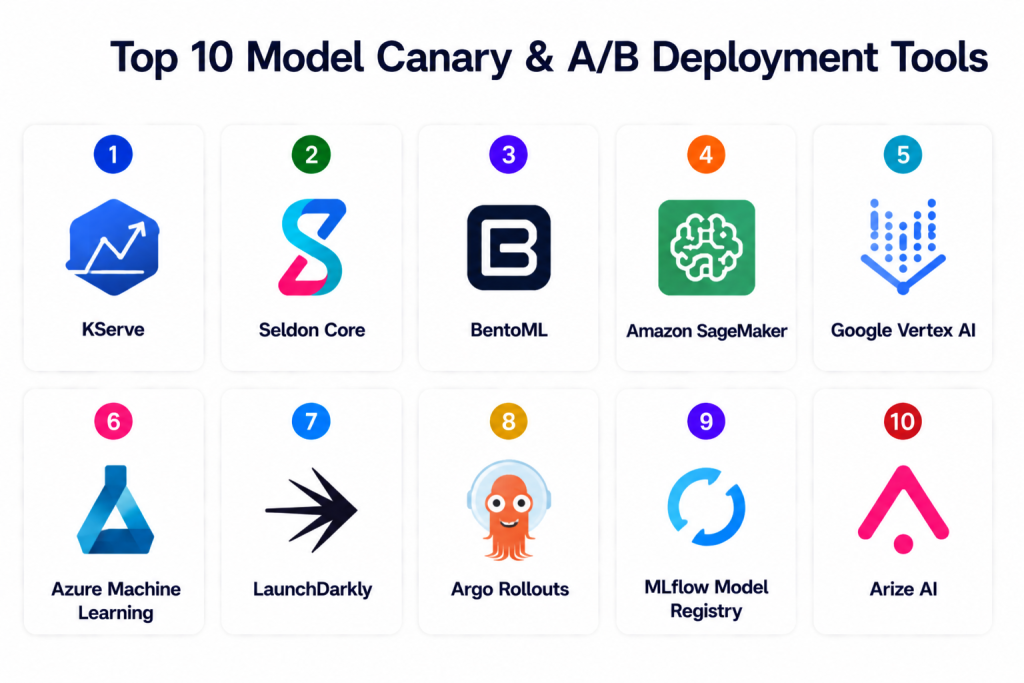
Top 10 Model Canary & A/B Deployment Tools
1 — KServe
One-line verdict: Best Kubernetes-native tool for controlled model rollout, canary deployment, and traffic splitting.
Short description: KServe provides Kubernetes-native model serving with support for canary rollouts, traffic splitting, autoscaling, and multiple ML runtimes. It is a strong choice for platform teams building portable inference infrastructure across cloud and on-prem environments.
Standout Capabilities
- Canary deployment support
- Traffic splitting between model versions
- Kubernetes-native serving
- Autoscaling with Knative
- Multi-framework model support
- Custom predictor support
- Integration with Kubeflow workflows
AI-Specific Depth
- Model support: Multi-framework and BYO models
- RAG / knowledge integration: Works with custom RAG serving stacks
- Evaluation: External evaluation integration
- Guardrails: Kubernetes policies and routing controls
- Observability: Prometheus and Kubernetes metrics
Pros
- Strong cloud portability
- Good for enterprise MLOps platforms
- Supports production rollout controls
Cons
- Requires Kubernetes expertise
- Setup can be complex
- Experiment analytics need external tools
Security & Compliance
RBAC, namespace isolation, ingress controls, service mesh security, and Kubernetes policy enforcement. Certifications are not publicly stated.
Deployment & Platforms
Cloud, on-prem, hybrid, Kubernetes.
Integrations & Ecosystem
KServe integrates well with Kubernetes-based AI stacks and deployment workflows.
- Kubernetes
- Kubeflow
- Knative
- Istio
- Prometheus
- Grafana
- CI/CD systems
Pricing Model
Open-source.
Best-Fit Scenarios
- Kubernetes model serving
- Canary rollout workflows
- Platform teams needing portability
2 — Seldon Core
One-line verdict: Best enterprise Kubernetes platform for advanced canary, A/B, and model graph deployments.
Short description: Seldon Core enables Kubernetes-native deployment of machine learning models with canary releases, A/B testing, model graphs, explainability integrations, and enterprise-grade rollout patterns.
Standout Capabilities
- Canary deployment support
- A/B testing workflows
- Model graph orchestration
- Traffic routing policies
- Explainer integration
- Monitoring support
- Multi-framework inference serving
AI-Specific Depth
- Model support: Multi-framework and BYO models
- RAG / knowledge integration: N/A
- Evaluation: External evaluation and monitoring workflows
- Guardrails: Traffic policies and Kubernetes controls
- Observability: Prometheus and Grafana integrations
Pros
- Strong deployment control
- Good for complex model graphs
- Enterprise-ready Kubernetes architecture
Cons
- Requires Kubernetes knowledge
- Advanced configuration can be complex
- Some governance workflows require add-ons
Security & Compliance
RBAC, service mesh security, ingress controls, audit logging through Kubernetes, and encryption through infrastructure. Certifications are not publicly stated.
Deployment & Platforms
Cloud, on-prem, hybrid, Kubernetes.
Integrations & Ecosystem
Seldon Core fits well into modern Kubernetes and MLOps environments.
- Kubernetes
- Istio
- Prometheus
- Grafana
- CI/CD tools
- Model registries
- Monitoring platforms
Pricing Model
Open-source with enterprise offerings.
Best-Fit Scenarios
- Enterprise model rollout
- A/B testing for inference endpoints
- Complex multi-model deployments
3 — BentoML
One-line verdict: Best developer-friendly platform for packaging models and supporting controlled rollout workflows.
Short description: BentoML helps teams package models into production APIs and deploy them across cloud, containers, Kubernetes, and serverless environments. Canary and A/B workflows can be implemented through deployment targets and traffic management layers.
Standout Capabilities
- Model packaging
- API-first serving
- Multi-framework support
- Containerized deployment
- Versioned services
- Deployment automation
- Cloud and Kubernetes support
AI-Specific Depth
- Model support: Multi-framework and BYO models
- RAG / knowledge integration: Custom connector support
- Evaluation: External testing integration
- Guardrails: API-level controls and deployment policies
- Observability: Logs and metrics through deployment stack
Pros
- Excellent developer experience
- Flexible deployment targets
- Good model packaging workflow
Cons
- Canary routing depends on deployment layer
- Enterprise governance needs additional setup
- Complex rollout analytics require integrations
Security & Compliance
Authentication, encryption, RBAC, audit controls, and security depend on deployment environment. Certifications are not publicly stated.
Deployment & Platforms
Cloud, on-prem, hybrid, containers, Kubernetes, serverless.
Integrations & Ecosystem
BentoML works well with CI/CD pipelines and modern AI API deployments.
- Docker
- Kubernetes
- CI/CD tools
- ML frameworks
- API gateways
- Monitoring tools
- Model registries
Pricing Model
Open-source with enterprise and managed options.
Best-Fit Scenarios
- AI API deployment
- Developer-led model releases
- Multi-framework serving workflows
4 — Amazon SageMaker
One-line verdict: Best AWS-native platform for managed canary, shadow, and A/B model deployment.
Short description: Amazon SageMaker provides managed model deployment, endpoint variants, shadow testing, traffic shifting, monitoring, and integration with AWS MLOps workflows.
Standout Capabilities
- Production variant traffic splitting
- Shadow testing
- Managed endpoints
- Auto rollback support through monitoring workflows
- Model registry integration
- Endpoint monitoring
- CI/CD integration
AI-Specific Depth
- Model support: AWS ecosystem and BYO models
- RAG / knowledge integration: AWS data ecosystem support
- Evaluation: SageMaker evaluation and monitoring workflows
- Guardrails: IAM and policy controls
- Observability: CloudWatch and SageMaker dashboards
Pros
- Fully managed deployment workflow
- Strong AWS integration
- Good enterprise security controls
Cons
- AWS lock-in
- Pricing complexity
- Less portable than open-source stacks
Security & Compliance
IAM, encryption, audit logging, network isolation, and AWS governance controls. Certifications follow AWS compliance programs.
Deployment & Platforms
AWS cloud.
Integrations & Ecosystem
SageMaker integrates deeply with AWS AI, data, and deployment services.
- SageMaker Pipelines
- SageMaker Model Registry
- CloudWatch
- S3
- IAM
- Lambda
- CI/CD services
Pricing Model
Usage-based.
Best-Fit Scenarios
- AWS-native model rollout
- Shadow testing production models
- Managed enterprise MLOps
5 — Google Vertex AI
One-line verdict: Best Google Cloud platform for managed model version rollout and traffic splitting.
Short description: Google Vertex AI supports managed model deployment, endpoint traffic splitting, model monitoring, and integrated MLOps workflows for cloud-native AI teams.
Standout Capabilities
- Endpoint traffic splitting
- Model version deployment
- Managed prediction endpoints
- Model monitoring integration
- Custom container support
- CI/CD compatibility
- Cloud-native governance
AI-Specific Depth
- Model support: Google models and BYO models
- RAG / knowledge integration: Google Cloud data ecosystem support
- Evaluation: Vertex evaluation workflows
- Guardrails: IAM and governance policies
- Observability: Cloud Monitoring dashboards
Pros
- Managed rollout workflows
- Strong Google Cloud integration
- Good support for custom containers
Cons
- Google Cloud lock-in
- Cost depends on traffic scale
- Less flexible outside cloud
Security & Compliance
IAM, encryption, audit logging, network controls, and Google Cloud governance. Certifications follow Google Cloud compliance programs.
Deployment & Platforms
Google Cloud.
Integrations & Ecosystem
Vertex AI connects model deployment with broader Google Cloud AI workflows.
- Vertex AI Pipelines
- Model Registry
- BigQuery
- Cloud Storage
- Cloud Monitoring
- CI/CD tools
Pricing Model
Usage-based.
Best-Fit Scenarios
- Google Cloud AI deployment
- Managed A/B traffic routing
- Enterprise model rollout governance
6 — Azure Machine Learning
One-line verdict: Best Azure-native model deployment platform for managed endpoints and safe rollout workflows.
Short description: Azure Machine Learning supports model deployment through managed online endpoints with traffic allocation, deployment versioning, monitoring, and governance controls.
Standout Capabilities
- Managed online endpoints
- Traffic allocation between deployments
- Model versioning
- Monitoring and logging
- CI/CD integration
- Enterprise identity controls
- Rollback workflows
AI-Specific Depth
- Model support: Azure ecosystem and BYO models
- RAG / knowledge integration: Azure data ecosystem support
- Evaluation: Azure ML evaluation workflows
- Guardrails: Azure RBAC and policy controls
- Observability: Azure Monitor dashboards
Pros
- Strong enterprise security
- Good endpoint rollout controls
- Deep Azure ecosystem integration
Cons
- Azure lock-in
- Cost can scale quickly
- Requires Azure ML knowledge
Security & Compliance
Azure RBAC, encryption, audit controls, private networking, and enterprise governance. Certifications follow Azure compliance programs.
Deployment & Platforms
Azure cloud.
Integrations & Ecosystem
Azure ML integrates with common enterprise cloud and MLOps workflows.
- Azure ML Registry
- Azure Monitor
- Azure DevOps
- GitHub Actions
- Data Lake
- Key Vault
- CI/CD pipelines
Pricing Model
Usage-based.
Best-Fit Scenarios
- Azure-native AI deployment
- Enterprise endpoint governance
- Safe traffic allocation workflows
7 — LaunchDarkly
One-line verdict: Best feature flag platform for controlling model exposure by segment and rollout percentage.
Short description: LaunchDarkly is a feature management platform that can control which users see specific model versions, prompts, or AI-powered features. It is useful when model releases need product-level segmentation and experimentation controls.
Standout Capabilities
- Feature flags
- Gradual rollout
- User segmentation
- Experimentation support
- Kill switches
- Audit logs
- Governance controls
AI-Specific Depth
- Model support: Model agnostic
- RAG / knowledge integration: N/A
- Evaluation: Business metric experimentation
- Guardrails: Kill switches and rollout policies
- Observability: Experiment and flag dashboards
Pros
- Excellent rollout control
- Strong user targeting
- Fast rollback through flags
Cons
- Not a model serving platform
- Requires integration with AI application layer
- Model metrics need external systems
Security & Compliance
RBAC, audit logs, SSO, approval workflows, and enterprise governance controls. Certifications vary by plan and vendor disclosure.
Deployment & Platforms
Cloud / SaaS.
Integrations & Ecosystem
LaunchDarkly integrates well with application delivery and experiment workflows.
- CI/CD tools
- Application frameworks
- Analytics platforms
- Observability systems
- Product experimentation tools
Pricing Model
Subscription-based.
Best-Fit Scenarios
- AI feature rollouts
- User-segmented model experiments
- Fast rollback for AI features
8 — Argo Rollouts
One-line verdict: Best Kubernetes-native rollout controller for canary and blue-green AI deployments.
Short description: Argo Rollouts extends Kubernetes deployment strategies with canary, blue-green, metric-based promotion, and automated rollback workflows.
Standout Capabilities
- Canary deployments
- Blue-green deployments
- Metric-based rollout promotion
- Automated rollback
- Kubernetes-native workflows
- GitOps compatibility
- Traffic routing integrations
AI-Specific Depth
- Model support: Framework agnostic through Kubernetes workloads
- RAG / knowledge integration: N/A
- Evaluation: Metric-based promotion through integrations
- Guardrails: Rollout policies and rollback controls
- Observability: Integrates with monitoring systems
Pros
- Strong Kubernetes rollout control
- GitOps-friendly
- Flexible metric-based promotion
Cons
- Not model-specific
- Requires Kubernetes expertise
- Needs external model monitoring
Security & Compliance
Uses Kubernetes RBAC, audit logs, namespace controls, and GitOps governance.
Deployment & Platforms
Cloud, on-prem, hybrid, Kubernetes.
Integrations & Ecosystem
Argo Rollouts fits well in GitOps and platform engineering workflows.
- Kubernetes
- Argo CD
- Istio
- NGINX
- Prometheus
- Datadog
- CI/CD systems
Pricing Model
Open-source.
Best-Fit Scenarios
- Kubernetes canary deployment
- GitOps model rollout
- Metric-driven production promotion
9 — MLflow Model Registry
One-line verdict: Best lightweight model registry foundation for version promotion and deployment governance.
Short description: MLflow Model Registry helps teams manage model versions, stages, approvals, metadata, and deployment promotion workflows. It is often paired with serving platforms for canary and A/B deployment.
Standout Capabilities
- Model versioning
- Stage transitions
- Approval workflows
- Artifact tracking
- Deployment metadata
- Experiment linkage
- API-based automation
AI-Specific Depth
- Model support: Multi-framework
- RAG / knowledge integration: N/A
- Evaluation: Experiment and metric comparison
- Guardrails: Approval policies through workflow design
- Observability: Registry metadata and experiment logs
Pros
- Simple model lifecycle control
- Strong open-source adoption
- Good for deployment governance
Cons
- Not a traffic router
- Needs serving platform integration
- Enterprise governance is limited
Security & Compliance
Access control depends on deployment. Enterprise distributions may add stronger governance. Certifications are not publicly stated.
Deployment & Platforms
Cloud, on-prem, hybrid.
Integrations & Ecosystem
MLflow works across common MLOps and serving systems.
- MLflow Tracking
- CI/CD pipelines
- Model serving platforms
- Data platforms
- Experiment workflows
Pricing Model
Open-source with managed options through ecosystem providers.
Best-Fit Scenarios
- Model version governance
- Approval-based deployment promotion
- Lightweight MLOps workflows
10 — Arize AI
One-line verdict: Best observability platform for validating model canaries and production A/B experiments.
Short description: Arize AI monitors deployed model performance, drift, prediction quality, and production behavior. It helps teams compare canary and baseline model performance before full rollout.
Standout Capabilities
- Model performance monitoring
- Drift detection
- Production comparison workflows
- Root-cause analysis
- Feature-level observability
- Alerts and dashboards
- LLM observability support
AI-Specific Depth
- Model support: Multi-model and BYO
- RAG / knowledge integration: Embedding and vector observability
- Evaluation: Production performance comparison
- Guardrails: Alerting and anomaly policies
- Observability: Full AI monitoring dashboards
Pros
- Strong production validation
- Excellent observability
- Useful for canary decision-making
Cons
- Not a deployment tool itself
- Requires integration with serving stack
- Premium pricing
Security & Compliance
RBAC, encryption, audit controls, and enterprise governance features. Certifications are not publicly stated.
Deployment & Platforms
Cloud / Hybrid.
Integrations & Ecosystem
Arize AI complements model serving, deployment, and monitoring workflows.
- Model serving systems
- Feature stores
- Data warehouses
- LLM pipelines
- Alerting tools
- MLOps platforms
Pricing Model
Enterprise subscription.
Best-Fit Scenarios
- Canary validation
- Production model monitoring
- A/B performance comparison
Comparison Table
| Tool | Best For | Deployment | Model Flexibility | Strength | Watch-Out | Public Rating |
|---|---|---|---|---|---|---|
| KServe | Kubernetes canary serving | Cloud / Hybrid / On-prem | Multi-framework | Traffic splitting | Kubernetes complexity | N/A |
| Seldon Core | Enterprise A/B deployments | Cloud / Hybrid / On-prem | Multi-framework | Model graph rollout | Setup effort | N/A |
| BentoML | Developer-led model APIs | Cloud / Hybrid | Multi-framework | Packaging workflow | Needs routing layer | N/A |
| SageMaker | AWS managed rollout | Cloud | AWS + BYO | Shadow testing | AWS lock-in | N/A |
| Vertex AI | Google managed rollout | Cloud | Google + BYO | Traffic splitting | GCP lock-in | N/A |
| Azure ML | Azure managed endpoints | Cloud | Azure + BYO | Traffic allocation | Azure lock-in | N/A |
| LaunchDarkly | Feature-level AI rollout | Cloud | Model agnostic | User targeting | Not model serving | N/A |
| Argo Rollouts | Kubernetes rollout control | Cloud / Hybrid / On-prem | Framework agnostic | Metric-based canary | Not ML-specific | N/A |
| MLflow Registry | Model version governance | Cloud / Hybrid / On-prem | Multi-framework | Lifecycle tracking | No traffic routing | N/A |
| Arize AI | Canary validation | Cloud / Hybrid | Multi-model | Observability | Not deployment tool | N/A |
Scoring & Evaluation
Scoring is comparative, not absolute. Deployment platforms score higher in rollout execution, while monitoring and registry tools score higher in governance and validation. Teams should evaluate tools based on where the biggest gap exists: traffic routing, experiment management, model governance, user segmentation, or production validation.
| Tool | Core | Reliability/Eval | Guardrails | Integrations | Ease | Perf/Cost | Security/Admin | Support | Weighted Total |
|---|---|---|---|---|---|---|---|---|---|
| KServe | 9 | 8 | 8 | 9 | 6 | 8 | 8 | 8 | 8.0 |
| Seldon Core | 9 | 8 | 8 | 8 | 6 | 8 | 8 | 8 | 7.9 |
| BentoML | 8 | 7 | 7 | 8 | 8 | 8 | 7 | 8 | 7.6 |
| SageMaker | 9 | 8 | 9 | 9 | 8 | 8 | 9 | 9 | 8.6 |
| Vertex AI | 9 | 8 | 9 | 9 | 8 | 8 | 9 | 9 | 8.6 |
| Azure ML | 9 | 8 | 9 | 9 | 8 | 8 | 9 | 9 | 8.6 |
| LaunchDarkly | 8 | 8 | 9 | 9 | 9 | 8 | 9 | 9 | 8.6 |
| Argo Rollouts | 8 | 8 | 8 | 9 | 7 | 8 | 8 | 8 | 8.0 |
| MLflow Registry | 7 | 8 | 7 | 8 | 8 | 8 | 7 | 8 | 7.6 |
| Arize AI | 8 | 9 | 8 | 9 | 8 | 8 | 9 | 8 | 8.4 |
Top 3 for Enterprise: SageMaker, Vertex AI, Azure ML
Top 3 for SMB: BentoML, MLflow Registry, LaunchDarkly
Top 3 for Developers: KServe, Argo Rollouts, BentoML
Which Model Canary & A/B Deployment Tool Is Right for You
Solo / Freelancer
BentoML and MLflow Registry are practical choices for lightweight model versioning and API deployment workflows. They give developers control without requiring large platform teams.
SMB
BentoML, LaunchDarkly, and Argo Rollouts work well for smaller teams that need controlled rollout, fast rollback, and flexible deployment patterns.
Mid-Market
KServe, Seldon Core, and Arize AI provide stronger production workflows for model rollout, traffic routing, and validation.
Enterprise
SageMaker, Vertex AI, Azure ML, and LaunchDarkly are strong options for enterprise teams that need governance, auditability, user targeting, and managed deployment workflows.
Regulated Industries
Managed cloud platforms and tools with strong audit controls are better for regulated environments. Arize AI also helps validate model performance during rollout.
Budget vs Premium
Open-source tools reduce licensing costs but require engineering expertise. Managed cloud services and enterprise feature flag platforms simplify operations but may increase long-term cost.
Build vs Buy
Build with Kubernetes-native tools if your team has platform engineering maturity. Buy managed services when speed, governance, and operational simplicity matter more.
Implementation Playbook
30 Days
- Identify one production model for controlled rollout
- Define baseline model metrics
- Set canary traffic percentage
- Configure rollback conditions
- Connect monitoring dashboards
60 Days
- Add A/B experiment metrics
- Integrate model registry and CI/CD workflows
- Add feature flag controls if needed
- Configure alerting and anomaly detection
- Validate performance against baseline
90 Days
- Standardize rollout templates
- Add approval workflows
- Expand canary deployment across model teams
- Automate rollback and promotion rules
- Build governance reports for production releases
Common Mistakes & How to Avoid Them
- Deploying new models directly to full traffic
- Running A/B tests without statistical confidence
- Ignoring latency and cost during canary testing
- Not connecting monitoring to rollout decisions
- No rollback plan
- Mixing model changes with product changes without tracking
- Missing segment-level performance analysis
- Ignoring drift during rollout
- No model registry integration
- Weak approval workflows
- Not validating fairness and safety metrics
- Using feature flags without model observability
- Poor experiment documentation
- Vendor lock-in without portability planning
FAQs
1. What is model canary deployment?
Model canary deployment gradually exposes a new model version to a small percentage of traffic before full rollout.
2. What is A/B testing for models?
A/B testing compares two or more model versions using live traffic and defined metrics such as accuracy, conversion, latency, or business impact.
3. What is shadow deployment?
Shadow deployment sends production-like traffic to a new model without affecting users, allowing teams to evaluate performance safely.
4. Which tools support Kubernetes canary deployment?
KServe, Seldon Core, and Argo Rollouts are strong Kubernetes-native options.
5. Which cloud tools support managed model rollout?
Amazon SageMaker, Google Vertex AI, and Azure Machine Learning provide managed model deployment and rollout features.
6. Do feature flags help with model deployment?
Yes. Feature flags help control which users or segments receive a model version or AI-powered feature.
7. Can model canary deployment reduce risk?
Yes. Canary rollout limits exposure and allows fast rollback if performance, safety, or latency issues appear.
8. What metrics should be monitored during canary rollout?
Teams should monitor accuracy, drift, latency, error rates, cost, fairness, business metrics, and user-level outcomes.
9. Is A/B deployment only for real-time models?
No. It is most common for real-time models but can also be used for batch workflows with controlled evaluation groups.
10. Do model registries replace deployment tools?
No. Model registries manage versions and approvals, while deployment tools handle traffic routing and serving.
11. What is champion-challenger deployment?
Champion-challenger compares a current production model against one or more candidate models before promotion.
12. How should teams choose a canary deployment tool?
Choose based on infrastructure, cloud ecosystem, traffic routing needs, governance requirements, and monitoring maturity.
Conclusion
Model Canary & A/B Deployment Tools help teams release AI models safely, compare real-world performance, and reduce production risk. Kubernetes-native platforms like KServe, Seldon Core, and Argo Rollouts offer strong flexibility for platform teams, while managed services such as SageMaker, Vertex AI, and Azure ML simplify rollout workflows for cloud-native enterprises. Feature flag platforms like LaunchDarkly provide user-level exposure control, while MLflow Registry and Arize AI help with governance and validation. The right tool depends on your infrastructure, experiment maturity, model risk level, and monitoring depth. Start with one high-value model, define rollout metrics, test canary rules, validate rollback workflows, and then standardize deployment practices across your AI teams.

Find Trusted Cardiac Hospitals
Compare heart hospitals by city and services — all in one place.
Explore Hospitals
Great comparison of canary and A/B deployment tools with practical insights and clear explanations.
Very useful for teams working on safe and reliable AI model deployments.