
Introduction
Data labeling and annotation platforms are the backbone of modern AI systems, especially for training computer vision models, large language models, autonomous systems, and enterprise-grade machine learning pipelines. In real-world AI development, raw data is useless until it is properly labeled, structured, and transformed into high-quality training signals. This is where annotation platforms play a critical role by combining human intelligence, automation, and AI-assisted workflows.
These platforms are now evolving beyond simple labeling tools into full-scale data operations systems that support multimodal annotation, workflow automation, quality assurance, active learning, and model feedback loops. Enterprises rely on them to ensure dataset accuracy, reduce bias, and accelerate AI model development.
Why It Matters
- Improves AI model accuracy and performance
- Reduces training data errors and bias
- Enables scalable ML and LLM development
- Supports multimodal AI datasets (text, image, video, 3D)
- Enhances human-in-the-loop workflows
- Speeds up dataset creation for production AI
Real-World Use Cases
- Autonomous driving datasets (LiDAR, video annotation)
- Healthcare imaging and medical AI training
- Chatbot and LLM training datasets
- Retail product recognition systems
- Fraud detection and financial AI models
- Speech and NLP dataset creation
- Robotics perception systems
- Document intelligence and OCR training
Evaluation Criteria for Buyers
- Annotation accuracy and QA systems
- AI-assisted labeling capabilities
- Multimodal data support
- Workflow automation and scalability
- Collaboration and workforce management
- Integration with ML pipelines
- Security and compliance readiness
- Active learning support
- Dataset versioning and governance
- Enterprise scalability
Best For
Organizations building production-grade AI/ML systems that require high-quality labeled datasets at scale with strong governance and automation.
Not Ideal For
Very small projects or one-time annotation needs where lightweight open-source tools may be sufficient.
What’s Changing in Data Labeling & Annotation Platforms
- AI-assisted labeling is reducing manual workload
- Active learning is becoming standard in workflows
- Multimodal annotation is replacing single-format labeling
- Human-in-the-loop systems are expanding rapidly
- Dataset versioning is becoming essential
- Enterprises are adopting managed annotation services
- Automation is improving labeling speed and accuracy
- Quality assurance pipelines are becoming stricter
- Annotation platforms now integrate directly with ML pipelines
- Generative AI is increasing demand for preference labeling
Quick Buyer Checklist
Before selecting a data labeling platform, verify:
- Multimodal annotation support
- AI-assisted labeling capabilities
- Quality control workflows
- Workforce scaling options
- Integration with ML pipelines
- Security and compliance readiness
- Active learning support
- Dataset management features
- API flexibility
- Enterprise governance tools
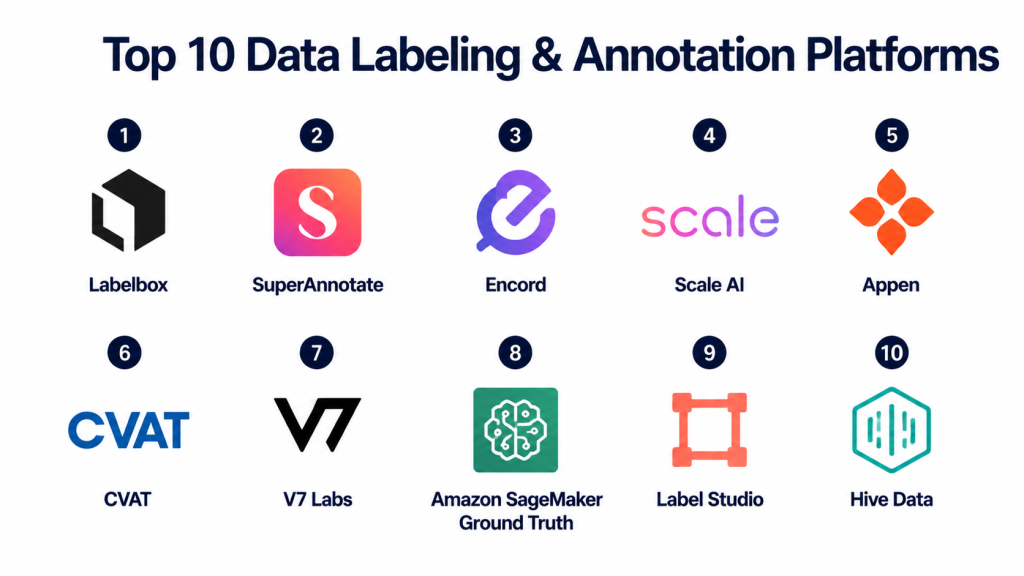
Top 10 Data Labeling & Annotation Platforms
1- Labelbox
2- SuperAnnotate
3- Encord
4- Scale AI
5- Appen
6- CVAT
7- V7 Labs
8- Amazon SageMaker Ground Truth
9- Label Studio
10- Hive Data
1. Labelbox
One-line Verdict
Best for enterprise-grade ML data operations and scalable annotation workflows.
Short Description
Labelbox is a leading data labeling platform designed for building and managing high-quality training datasets for AI and machine learning systems. It supports image, video, text, and multimodal annotation with strong workflow automation and collaboration features. Enterprises use Labelbox to scale dataset creation while maintaining strict quality control.
The platform is widely used in computer vision and NLP pipelines where accuracy and dataset governance are critical for production AI systems.
Standout Capabilities
- Multimodal annotation support
- AI-assisted labeling tools
- Dataset versioning system
- Workflow automation engine
- Human-in-the-loop review
- Active learning integration
- API-driven data pipelines
- Enterprise collaboration tools
AI-Specific Depth
Labelbox improves model training efficiency by combining human annotation with machine learning-assisted pre-labeling, reducing manual workload and improving dataset consistency.
Pros
- Strong enterprise scalability
- Flexible annotation workflows
- Good ML integration support
Cons
- Can be complex for beginners
- Pricing may scale with usage
- Requires setup for advanced workflows
Security & Compliance
Enterprise-grade security and governance features supported.
Deployment & Platforms
- Cloud-based platform
- Enterprise integrations
Integrations & Ecosystem
- AWS SageMaker
- Google Cloud AI
- Azure ML
- PyTorch workflows
- TensorFlow pipelines
Pricing Model
Enterprise subscription-based pricing.
Best-Fit Scenarios
- Large-scale AI dataset creation
- Computer vision model training
- Enterprise ML pipelines
2. SuperAnnotate
One-line Verdict
Best for fast, collaborative AI-assisted annotation at scale.
Short Description
SuperAnnotate is a high-performance data labeling platform designed for teams that need fast annotation workflows with strong collaboration and automation capabilities. It supports image, video, and text annotation with AI-assisted labeling features that speed up dataset creation significantly.
It is widely used by AI teams building computer vision and generative AI applications requiring large annotated datasets.
Standout Capabilities
- AI-assisted labeling
- Collaborative annotation workspace
- Advanced QA workflows
- Dataset management tools
- Model-assisted pre-labeling
- Active learning support
- Video annotation tools
- Performance analytics
AI-Specific Depth
SuperAnnotate reduces manual annotation effort by automatically pre-labeling data and allowing human reviewers to refine outputs, improving dataset efficiency.
Pros
- Very fast annotation workflows
- Strong collaboration features
- High-quality QA system
Cons
- Learning curve for advanced features
- Enterprise features may be expensive
- Requires setup for automation pipelines
Security & Compliance
Enterprise security controls supported.
Deployment & Platforms
- Cloud platform
- Enterprise deployments
Integrations & Ecosystem
- ML frameworks
- Cloud AI platforms
- Dataset pipelines
- Annotation APIs
Pricing Model
Subscription-based pricing.
Best-Fit Scenarios
- Computer vision training
- Large annotation teams
- AI dataset scaling
3. Encord
One-line Verdict
Best for multimodal AI annotation and complex dataset management.
Short Description
Encord is a powerful annotation and data curation platform designed for enterprise AI teams working with complex multimodal datasets. It supports image, video, medical data, and 3D annotation with advanced workflow orchestration and quality analytics.
The platform is highly suited for regulated industries and production AI systems requiring high-precision labeling.
Standout Capabilities
- Multimodal annotation support
- Advanced dataset curation
- Quality analytics dashboards
- Active learning workflows
- Ontology management
- Human-in-the-loop validation
- AI-assisted labeling
- Enterprise governance tools
AI-Specific Depth
Encord helps teams build high-quality training datasets using structured annotation pipelines and automated quality control mechanisms.
Pros
- Excellent multimodal support
- Strong enterprise governance
- Advanced annotation workflows
Cons
- Complex for small teams
- Higher cost for enterprise features
- Requires onboarding time
Security & Compliance
Strong enterprise-grade compliance support.
Deployment & Platforms
- Cloud-based
- Enterprise deployments
Integrations & Ecosystem
- ML pipelines
- Cloud storage systems
- AI frameworks
- Annotation APIs
Pricing Model
Enterprise pricing model.
Best-Fit Scenarios
- Medical AI datasets
- Autonomous systems
- Complex multimodal AI
4. Scale AI
One-line Verdict
Best for large-scale managed annotation and enterprise AI training data.
Short Description
Scale AI provides managed data labeling services and platforms for enterprise-grade AI development. It specializes in large-scale annotation projects involving autonomous driving, LLM training, and multimodal datasets.
The platform combines human workforce scaling with AI-assisted labeling tools.
Standout Capabilities
- Large-scale data labeling
- RLHF dataset generation
- Multimodal annotation
- Human-in-the-loop workflows
- Enterprise data pipelines
- Quality assurance systems
- AI-assisted labeling
- Custom annotation workflows
AI-Specific Depth
Scale AI is widely used for reinforcement learning from human feedback datasets and large-scale AI model training.
Pros
- Massive workforce scalability
- High-quality enterprise datasets
- Strong multimodal support
Cons
- Premium pricing model
- Less self-serve flexibility
- Enterprise-focused usage
Security & Compliance
Enterprise-grade security and compliance controls.
Deployment & Platforms
- Managed service platform
- Enterprise integration
Integrations & Ecosystem
- LLM training pipelines
- Autonomous systems
- Cloud AI platforms
Pricing Model
Enterprise contract-based pricing.
Best-Fit Scenarios
- Autonomous driving datasets
- LLM training data
- Large enterprise AI programs
5. Appen
One-line Verdict
Best for global workforce-driven NLP and speech annotation.
Short Description
Appen is a global data annotation company specializing in NLP, speech, and multilingual datasets. It provides large-scale human-powered labeling services for enterprises building AI models across languages and regions.
It is widely used in conversational AI and speech recognition systems.
Standout Capabilities
- Multilingual data labeling
- Speech annotation
- NLP dataset creation
- Global workforce scaling
- Human evaluation systems
- AI training support
- Content moderation datasets
- Enterprise workflows
AI-Specific Depth
Appen enables high-quality NLP and speech dataset creation using distributed human annotation systems.
Pros
- Strong multilingual support
- Large global workforce
- Good NLP capabilities
Cons
- Slower than automated platforms
- Less automation tooling
- Service-heavy model
Security & Compliance
Enterprise-level compliance support available.
Deployment & Platforms
- Managed service
- Cloud workflows
Integrations & Ecosystem
- NLP pipelines
- Speech AI systems
- Enterprise ML platforms
Pricing Model
Service-based pricing.
Best-Fit Scenarios
- NLP training datasets
- Speech recognition systems
- Multilingual AI models
6. CVAT
One-line Verdict
Best open-source annotation tool for computer vision projects.
Short Description
CVAT is a widely used open-source annotation tool designed for computer vision datasets. It supports image and video annotation with bounding boxes, segmentation, and tracking features.
It is highly popular among researchers and engineering teams.
Standout Capabilities
- Open-source annotation platform
- Image and video labeling
- Object detection tools
- Segmentation support
- Tracking features
- Self-hosted deployment
- Custom workflows
- Plugin architecture
AI-Specific Depth
CVAT enables flexible dataset labeling for computer vision models with full control over annotation pipelines.
Pros
- Free and open-source
- Highly flexible
- Strong CV support
Cons
- Requires self-management
- Limited enterprise features
- No managed workforce
Security & Compliance
Depends on self-hosted deployment.
Deployment & Platforms
- Self-hosted
- Cloud deployment possible
Integrations & Ecosystem
- Open-source ML tools
- Computer vision frameworks
Pricing Model
Free open-source.
Best-Fit Scenarios
- Research projects
- CV model training
- Budget-conscious teams
7. V7 Labs
One-line Verdict
Best for AI-assisted computer vision annotation workflows.
Short Description
V7 Labs provides a modern annotation platform focused on computer vision and AI-assisted labeling. It supports automation features, dataset management, and model training workflows.
It is widely used in industrial AI and visual recognition systems.
Standout Capabilities
- AI-assisted annotation
- Image and video labeling
- Dataset versioning
- Workflow automation
- Active learning tools
- Object tracking
- Collaboration features
- API integrations
AI-Specific Depth
V7 Labs enhances dataset creation using automation and AI-assisted pre-labeling to reduce manual annotation effort.
Pros
- Strong automation features
- Easy collaboration
- Good CV capabilities
Cons
- Limited NLP support
- Enterprise pricing constraints
- Requires setup for scaling
Security & Compliance
Enterprise-grade controls available.
Deployment & Platforms
- Cloud platform
- Enterprise deployment
Integrations & Ecosystem
- ML pipelines
- Cloud storage systems
Pricing Model
Subscription-based pricing.
Best-Fit Scenarios
- Computer vision AI
- Industrial automation systems
- Dataset creation pipelines
8. Amazon SageMaker Ground Truth
One-line Verdict
Best for AWS-native data labeling workflows.
Short Description
Amazon SageMaker Ground Truth is a managed data labeling service within the AWS ecosystem. It combines human labeling, automation, and active learning to create high-quality datasets for machine learning models.
It integrates deeply with AWS ML services.
Standout Capabilities
- Managed labeling service
- Active learning workflows
- AWS integration
- Human-in-the-loop labeling
- Automated labeling
- Scalable workforce
- Data security controls
- ML pipeline integration
AI-Specific Depth
Ground Truth uses model-assisted labeling to reduce human effort while maintaining dataset quality.
Pros
- Strong AWS integration
- Scalable managed service
- Reliable automation features
Cons
- AWS ecosystem dependency
- Pricing complexity
- Limited external flexibility
Security & Compliance
AWS enterprise-grade security.
Deployment & Platforms
- AWS cloud only
Integrations & Ecosystem
- AWS SageMaker
- AWS ML services
Pricing Model
Usage-based AWS pricing.
Best-Fit Scenarios
- AWS-based ML pipelines
- Enterprise AI workloads
- Scalable labeling systems
9. Label Studio
One-line Verdict
Best flexible open-source annotation platform for multiple data types.
Short Description
Label Studio is an open-source data labeling platform that supports text, image, audio, and video annotation. It is highly customizable and widely used in both research and production environments.
Standout Capabilities
- Multi-format annotation
- Open-source flexibility
- Custom workflows
- API integration
- ML-assisted labeling
- Plugin ecosystem
- Collaboration tools
- Dataset management
AI-Specific Depth
Label Studio supports flexible annotation pipelines for training diverse AI models across modalities.
Pros
- Highly flexible
- Open-source ecosystem
- Supports multiple data types
Cons
- Requires setup effort
- Limited enterprise features
- UI customization needed
Security & Compliance
Depends on deployment setup.
Deployment & Platforms
- Self-hosted
- Cloud deployment options
Integrations & Ecosystem
- ML frameworks
- Cloud storage systems
Pricing Model
Free open-source + enterprise options.
Best-Fit Scenarios
- Research projects
- Multi-modal AI datasets
- Custom workflows
10. Hive Data
One-line Verdict
Best for scalable managed annotation and AI data pipelines.
Short Description
Hive Data provides large-scale data annotation services combined with automation and AI-assisted workflows. It specializes in enterprise-grade dataset creation for computer vision, NLP, and multimodal AI systems.
Standout Capabilities
- Managed annotation services
- Computer vision labeling
- NLP dataset creation
- AI-assisted workflows
- Quality control systems
- Scalable workforce
- API integrations
- Enterprise pipelines
AI-Specific Depth
Hive Data combines automation and human labeling to improve dataset accuracy and scale.
Pros
- Strong managed services
- Scalable workforce
- Good enterprise support
Cons
- Less self-serve control
- Service-dependent model
- Limited customization flexibility
Security & Compliance
Enterprise-grade security available.
Deployment & Platforms
- Managed cloud service
Integrations & Ecosystem
- ML pipelines
- Enterprise AI systems
Pricing Model
Service-based pricing.
Best-Fit Scenarios
- Enterprise AI programs
- Large dataset creation
- Multimodal AI systems
Comparison Table
| Tool | Best For | Deployment | Multimodal Support | AI Assistance | Enterprise Scale |
|---|---|---|---|---|---|
| Labelbox | Enterprise ML pipelines | Cloud | High | Yes | Very High |
| SuperAnnotate | Fast annotation workflows | Cloud | High | Yes | High |
| Encord | Complex multimodal AI | Cloud | Very High | Yes | Very High |
| Scale AI | Large managed datasets | Service | Very High | Yes | Very High |
| Appen | NLP & speech data | Service | Medium | Partial | High |
| CVAT | Open-source CV labeling | Self-hosted | High | No | Medium |
| V7 Labs | CV automation | Cloud | High | Yes | High |
| SageMaker Ground Truth | AWS ML pipelines | AWS Cloud | High | Yes | Very High |
| Label Studio | Flexible annotation | Self-hosted | High | Partial | Medium |
| Hive Data | Managed labeling services | Service | High | Yes | High |
Scoring & Evaluation Table
| Tool | Core Features | Ease of Use | Integrations | Security | Performance | Support | Value | Weighted Total |
|---|---|---|---|---|---|---|---|---|
| Labelbox | 9.2 | 8.7 | 9.0 | 9.0 | 8.8 | 8.7 | 8.5 | 8.9 |
| SuperAnnotate | 9.0 | 9.0 | 8.7 | 8.6 | 9.1 | 8.5 | 8.8 | 8.9 |
| Encord | 9.3 | 8.4 | 8.9 | 9.2 | 9.0 | 8.6 | 8.4 | 8.9 |
| Scale AI | 9.5 | 8.0 | 8.8 | 9.3 | 9.4 | 8.8 | 8.0 | 9.0 |
| Appen | 8.8 | 8.3 | 8.5 | 8.7 | 8.4 | 8.6 | 8.6 | 8.5 |
| CVAT | 8.5 | 8.6 | 8.2 | 8.0 | 8.5 | 7.8 | 9.3 | 8.3 |
| V7 Labs | 8.7 | 8.8 | 8.4 | 8.6 | 8.7 | 8.4 | 8.6 | 8.6 |
| SageMaker Ground Truth | 9.1 | 8.5 | 9.2 | 9.4 | 9.0 | 8.9 | 8.2 | 8.9 |
| Label Studio | 8.6 | 8.8 | 8.6 | 8.2 | 8.5 | 8.0 | 9.0 | 8.5 |
| Hive Data | 8.8 | 8.2 | 8.5 | 8.8 | 8.7 | 8.6 | 8.3 | 8.5 |
Top 3 Recommendations
Best for Enterprise
- Labelbox
- Scale AI
- Encord
Best for SMBs
- SuperAnnotate
- V7 Labs
- Label Studio
Best for Developers
- CVAT
- Label Studio
- Ragas-style annotation pipelines (custom setups)
Which Data Labeling Platform Is Right for You
For Solo Developers
CVAT and Label Studio are ideal due to open-source flexibility and zero cost.
For SMBs
SuperAnnotate and V7 Labs provide strong automation and collaboration without heavy enterprise overhead.
For Mid-Market Organizations
Labelbox and Encord offer balanced scalability, governance, and multimodal support.
For Enterprise AI Programs
Scale AI, SageMaker Ground Truth, and Hive Data are best suited for large-scale, governed annotation operations.
Budget vs Premium
Open-source tools reduce cost but require engineering effort, while managed platforms offer scalability at higher pricing.
Feature Depth vs Ease of Use
Encord and Labelbox offer advanced capabilities, while SuperAnnotate focuses on usability and speed.
Integrations & Scalability
AWS-native and cloud-first platforms are best for enterprise-scale ML pipelines.
Security & Compliance Needs
Highly regulated industries should prioritize Encord, Scale AI, and SageMaker Ground Truth.
Implementation Playbook
First 30 Days
- Define annotation taxonomy
- Select labeling tool
- Build initial dataset structure
- Set QA guidelines
- Test small annotation batches
Days 30–60
- Introduce automation features
- Add AI-assisted labeling
- Optimize workflow pipelines
- Train annotation workforce
- Improve dataset quality metrics
Days 60–90
- Scale dataset production
- Introduce active learning
- Automate QA workflows
- Integrate with ML pipelines
- Optimize labeling cost and speed
Common Mistakes and How to Avoid Them
- Poorly defined labeling guidelines
- Ignoring QA workflows
- Over-reliance on manual annotation
- Not using AI-assisted labeling
- Lack of dataset versioning
- Weak taxonomy design
- Poor workforce training
- Ignoring edge-case labeling
- No active learning strategy
- Overcomplicated annotation workflows
- Weak integration with ML pipelines
- Lack of performance benchmarking
Frequently Asked Questions
1. What are data labeling platforms used for?
They are used to annotate raw data like images, text, video, and audio to create training datasets for AI models.
2. Why is data labeling important in AI?
AI models require labeled data to learn patterns, improve accuracy, and generate reliable predictions.
3. What is multimodal annotation?
It refers to labeling multiple data types such as image, video, text, and 3D data within a single platform.
4. Which tool is best for enterprise AI?
Labelbox, Scale AI, and Encord are widely used in enterprise AI programs.
5. Are open-source annotation tools reliable?
Yes, tools like CVAT and Label Studio are widely used in research and production environments.
6. What is AI-assisted labeling?
It uses machine learning models to pre-label data, reducing manual annotation effort.
7. What industries use annotation platforms?
Industries include healthcare, automotive, finance, ecommerce, robotics, and NLP systems.
8. What is active learning in annotation?
It is a process where models suggest the most useful data samples for annotation to improve training efficiency.
9. How do enterprises ensure data quality?
Through QA workflows, human review, automation checks, and validation pipelines.
10. What should be prioritized when choosing a platform?
Accuracy, scalability, workflow automation, integration support, and security compliance.
Conclusion
Data labeling and annotation platforms are a foundational layer of modern AI development, enabling organizations to transform raw data into structured intelligence for training machine learning and generative AI systems. As AI models become more advanced and multimodal, the need for scalable, automated, and high-quality annotation systems continues to grow rapidly. Platforms like Labelbox, Encord, Scale AI, and SuperAnnotate are redefining how enterprises build datasets by combining human intelligence with AI-assisted workflows. Choosing the right platform depends on dataset complexity, scale requirements, integration needs, and governance standards. Organizations that invest in strong annotation infrastructure will significantly improve model accuracy, reduce training time, and accelerate AI innovation across real-world applications.

Find Trusted Cardiac Hospitals
Compare heart hospitals by city and services — all in one place.
Explore Hospitals
A very clear and detailed comparison that explains how AI data labeling and annotation platforms power high-quality AI systems by improving dataset accuracy, scalability, and overall model performance.