
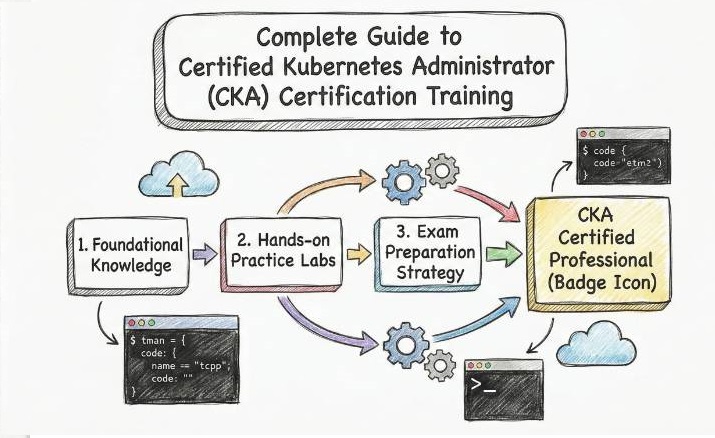
In the world of modern infrastructure, Kubernetes has become the standard. Whether you are managing a small startup’s microservices or a massive global enterprise’s data center, Kubernetes is likely the engine under the hood. For working engineers and managers in India and across the globe, staying relevant means mastering container orchestration.
The Certified Kubernetes Administrator (CKA) is more than just a certificate; it is a validation of your ability to handle production-grade clusters. Let’s break down exactly how you can master this and where it fits into your career.
The Kubernetes Certification Landscape
Before we dive deep into the CKA, let’s look at where it sits in the broader ecosystem. Use this table to understand the various tracks available today.
Kubernetes & Cloud-Native Certification Overview
| Track | Level | Who it’s for | Prerequisites | Skills Covered | Recommended Order |
| KCNA | Foundational | Beginners, Managers | Basic Cloud Knowledge | Ecosystem, Architecture | 1st (Optional) |
| CKAD | Intermediate | Developers | Linux Basics | App Deployment, Jobs | 1st or 2nd |
| CKA | Professional | Admins, SREs | Linux, Containers | Cluster Setup, Network | 2nd (Essential) |
| CKS | Expert | Security Engineers | Valid CKA | Hardening, Monitoring | 3rd (Final) |
Certified Kubernetes Administrator (CKA)
The CKA is unique because it is a performance-based exam. You aren’t answering multiple-choice questions; you are logged into a real command-line interface solving real-world problems.
What it is
The CKA program was created by the Linux Foundation and the CNCF to help develop the Kubernetes ecosystem. It ensures that administrators have the skills to install, configure, and manage production-grade Kubernetes clusters. It covers the core components of the control plane and worker nodes.
Who should take it
- DevOps Engineers who need to automate container orchestration.
- System Administrators transitioning from traditional VMs to cloud-native stacks.
- Site Reliability Engineers (SREs) focused on cluster uptime and performance.
- Software Engineers who want to understand the infrastructure their code runs on.
Skills you’ll gain
- Cluster Architecture: Building clusters from scratch using
kubeadm. - Workloads & Scheduling: Managing deployments, rollouts, and scaling.
- Services & Networking: Configuring Ingress, Load Balancers, and DNS.
- Storage: Setting up Persistent Volumes (PV) and Claims (PVC).
- Troubleshooting: Diagnosing failures in nodes, networks, and pods.
Real-world projects you should be able to do after it
- Production Cluster Setup: Deploy a highly available Kubernetes cluster on-prem or in the cloud.
- Automated Scaling: Implement Horizontal Pod Autoscalers (HPA) for fluctuating traffic.
- Zero-Downtime Updates: Manage rolling updates for legacy applications.
- Secure Networking: Define Network Policies to isolate sensitive microservices.
- Disaster Recovery: Backup and restore the
etcddatabase to prevent data loss.
Preparation Plan
- 7–14 Days (The Expert Sprint): Only for those using
kubectldaily. Spend 4 hours a day on mock exams (like Killer.sh) and practice manual cluster bootstraps. - 30 Days (The Professional Path): Spend 2 hours daily. Weeks 1-2: Theory and basic labs. Week 3: Complex networking and storage. Week 4: Speed-testing and troubleshooting.
- 60 Days (The Foundation Path): For those new to Linux/Containers. Spend month one on Linux administration and Docker. Spend month two on the CKA curriculum.
Common mistakes
- Over-relying on YAML: Don’t write YAML from scratch; use
kubectlimperative commands to generate templates. - Bad Time Management: Spending 30 minutes on a 2% weightage question. Skip and move on!
- Ignoring the Docs: The exam is open-book (official docs only). Learn how to use the search bar effectively.
- Context Errors: Not switching to the correct cluster context before running commands.
Best next certification after this
The logical next step is the Certified Kubernetes Security Specialist (CKS). Once you know how to build the cluster, you must learn how to lock it down.
Choose Your Path: 6 Modern Learning Tracks
Kubernetes is the foundation for almost every “Ops” role today. Here is how the CKA fits into your specific career choice:
1. DevOps Path
Focus on the CI/CD pipeline. Kubernetes acts as the deployment target. Here, the CKA helps you build the platforms that developers use to ship code daily.
2. DevSecOps Path
Security is “shifted left.” After CKA, you integrate automated security scanning (Trivy, Falco) into your Kubernetes workloads to ensure every container is compliant.
3. SRE (Site Reliability Engineering) Path
Reliability is the goal. You use Kubernetes to manage error budgets, SLOs, and SLIs. CKA gives you the deep troubleshooting skills needed to handle production incidents.
4. AIOps/MLOps Path
AI and Machine Learning models require massive, scalable compute. You will use Kubernetes (specifically tools like Kubeflow) to manage the lifecycle of your AI models.
5. DataOps Path
Managing data at scale. You’ll use Kubernetes to orchestrate data pipelines and databases like Postgres or MongoDB using Operators.
6. FinOps Path
Cloud costs can spiral out of control. As a FinOps practitioner with CKA knowledge, you understand resource requests and limits, which allows you to optimize cluster spending.
Role → Recommended Certifications Mapping
| Your Current/Target Role | Recommended Certifications |
| DevOps Engineer | CKA, CKAD, AWS Certified DevOps Engineer |
| Site Reliability Engineer (SRE) | CKA, SRE Foundation, CKS |
| Platform Engineer | CKA, Terraform Associate, CKS |
| Cloud Engineer | CKA, AWS/Azure/GCP Architect Professional |
| Security Engineer | CKA, CKS, CISSP |
| Data Engineer | CKA, Google Professional Data Engineer |
| FinOps Practitioner | FinOps Certified Practitioner, CKA |
| Engineering Manager | KCNA, CKA (for technical oversight) |
Next Certifications to Take
After you have mastered the CKA, your growth doesn’t stop. Based on global trends for software engineers, here are three ways to move forward:
- Same Track (Deepening Skills): Certified Kubernetes Security Specialist (CKS). This is the ultimate “hard mode” certification for Kubernetes experts.
- Cross-Track (Broadening Skills): AWS Certified Solutions Architect – Professional. Kubernetes rarely exists in a vacuum; mastering the underlying cloud provider is vital.
- Leadership (Management Path): Certified Software Development Professional (CSDP). For those moving into Director or VP roles, focusing on the software lifecycle and team management is the next logical step.
Top Institutions for Training & Certification
Choosing where to train is as important as the exam itself. Here are the top providers I recommend for CKA preparation:
1. DevOpsSchool
DevOpsSchool is a global leader in high-end technical training, specifically known for its deep-dive approach to Kubernetes. Their CKA program is built around the “Learn by Doing” philosophy, offering 80% practical lab sessions and 20% theory. They provide lifetime access to their Learning Management System (LMS) and offer robust support for clearing the exam on your first attempt.
2. Cotocus
Cotocus specializes in consulting-led training, which means their instructors are active practitioners who manage production clusters daily. This institution is excellent for engineers who want to understand the “why” behind the “how,” as they focus on real-world troubleshooting scenarios. Their CKA curriculum is strictly aligned with the latest CNCF standards to ensure exam readiness.
3. Scmgalaxy
Scmgalaxy is more than just a training center; it is a massive knowledge repository and community for DevOps professionals. They offer a unique blend of free community resources and premium instructor-led bootcamps for the CKA. Their training materials often include advanced “cheatsheets” and command-line hacks that are invaluable during the high-pressure 2-hour CKA exam.
4. BestDevOps
BestDevOps focuses on intensive, fast-paced training modules designed for working professionals who need to get certified without taking long breaks from work. They are highly rated for their “Exam Simulation” environments, which mimic the actual CKA terminal. Their focus is on efficiency, helping students master the core 17-20 tasks required to pass.
5. DevSecOpsSchool
As security becomes a core part of the Kubernetes lifecycle, DevSecOpsSchool provides a version of CKA training that emphasizes “Security by Design.” While covering the standard CKA syllabus, they add extra layers on RBAC, Network Policies, and Secrets management. It is the perfect starting point if you plan to take the CKS (Certified Kubernetes Security Specialist) immediately after.
6. SRESchool
SRESchool tailors its Kubernetes training toward reliability and performance. Their CKA program focuses heavily on the “Troubleshooting” and “Maintenance” sections of the exam, which account for 40% of the total score. They teach you how to treat Kubernetes not just as a platform, but as a system that requires constant health monitoring and automated self-healing.
7. AIOpsSchool
AIOpsSchool bridges the gap between infrastructure and Artificial Intelligence. Their CKA training is unique because it uses AI-driven tools to help learners identify patterns in cluster failures. This institution is ideal for engineers who want to manage the massive compute clusters required for modern Machine Learning workloads and high-velocity data processing.
8. DataOpsSchool
DataOpsSchool focuses on the storage and stateful aspects of Kubernetes. Since the CKA exam requires a solid understanding of Persistent Volumes and Claims, this school provides extra labs on managing databases like Postgres or MongoDB within a cluster. They are the best choice for Data Engineers who need to move their data pipelines into a containerized environment.
9. FinOpsSchool
FinOpsSchool is the go-to for managers and lead engineers who need to manage the cost of Kubernetes. Their CKA training includes specialized modules on resource requests, limits, and quotas. By learning CKA through a FinOps lens, you gain the skills to build clusters that are not only stable but also cost-optimized for your organization.
FAQs (General Career & Value)
1. How difficult is the CKA exam?
It is considered one of the harder certifications because it is 100% hands-on. You must know the commands; there is no guessing.
2. How much time does it take to prepare?
For a working professional, 4 to 6 weeks is the sweet spot.
3. Are there any prerequisites?
Technically, no. However, a strong grasp of Linux and Docker is highly recommended.
4. What is the passing score?
You need a 66% to pass the CKA exam.
5. How long is the certification valid?
It is valid for 3 years. After that, you must recertify to stay current with Kubernetes versions.
6. Is the CKA better than the CKAD?
They serve different purposes. CKA is for those who manage the cluster; CKAD is for those who build applications to run on it. CKA generally holds more weight for infrastructure roles.
7. Can I use the official documentation during the exam?
Yes. You are allowed to have one tab open with the official Kubernetes documentation.
8. Is the exam proctored?
Yes, it is remotely proctored. You will need a webcam and a quiet, private room.
9. Does CKA help in getting a remote job?
Absolutely. Global companies hire CKAs because it proves you can manage complex systems without hand-holding.
10. What is the average salary increase after CKA?
While it varies by region, certified engineers in India and globally often see a 20-30% jump in compensation.
11. Should I learn Docker before Kubernetes?
Yes. Kubernetes orchestrates containers; if you don’t understand how a single container works, managing a cluster will be very difficult.
12. Is the CKA worth it in 2026?
More than ever. As more companies move to “Cloud Native,” the demand for skilled administrators continues to outpace supply.
FAQs (CKA Training Specific)
1. What version of Kubernetes does the exam use?
The exam is usually updated within a few weeks of a new Kubernetes minor release. Always check the official CNCF site for the current version.
2. What if I fail the first attempt?
Most registrations through official providers like DevOpsSchool include one free retake.
3. Do I need to be a Linux expert?
You don’t need to be a kernel developer, but you should be comfortable with file editing (vim/nano), systemd, and basic networking commands.
4. Can I take the exam on a Mac or Windows?
Yes, the exam is taken through a browser (Chrome/Chromium), so the OS doesn’t matter as much as the browser stability.
5. How many questions are on the exam?
Expect between 15 and 20 performance-based tasks.
6. Is there a lot of networking in the CKA?
Yes, about 20% of the exam covers Services and Networking. It is often the section where most people struggle.
7. Should I take the KCNA before CKA?
Only if you are a complete beginner. If you are an engineer with some experience, you can jump straight to CKA.
8. How do I practice for the CKA?
Set up a local cluster using Minikube, or use cloud-based labs provided by institutions like Scmgalaxy or DevOpsSchool.
Conclusion
As we look at the landscape of modern engineering, it is clear that the “Ops” world has shifted permanently toward containerization. The Certified Kubernetes Administrator (CKA) is not just another badge for your LinkedIn profile; it is a rigorous validation that you can handle the complexities of a live, production-grade environment.
In my time watching technology cycles evolve, I have seen many tools come and go, but Kubernetes has solidified itself as the “Operating System” of the cloud. Mastering it doesn’t just make you a better administrator; it makes you a more versatile engineer, a more informed manager, and a highly sought-after professional in a competitive global market. If you are a working engineer or a manager today, the complexity of the cloud can feel overwhelming. However, by breaking your learning own into the paths we’ve discussed—whether that’s moving towar SRE, DevSecOps, or FinOps—you turn that complexity into a career advantage.

Find Trusted Cardiac Hospitals
Compare heart hospitals by city and services — all in one place.
Explore Hospitals
I like how you broke down the CKA certification path and what it takes to prepare — that makes it feel a lot more manageable instead of overwhelming. The practical tips and milestones you included are especially useful for someone starting their Kubernetes journey. Thanks for putting together a clear and comprehensive guide! 😊