
Introduction
Knowledge Graph Construction Tools help organizations transform disconnected structured and unstructured data into connected semantic networks that represent entities, relationships, events, and contextual meaning. These platforms are widely used in enterprise AI, semantic search, retrieval augmented generation, fraud detection, recommendation systems, digital twins, customer intelligence, cybersecurity analytics, and AI agent memory systems.
Modern AI systems increasingly depend on knowledge graphs because large language models alone struggle with explainability, traceability, relationship reasoning, and structured contextual understanding. Knowledge graph construction platforms solve this by connecting people, systems, documents, events, products, and business concepts into machine-readable semantic structures. Modern GraphRAG systems are now combining vector retrieval with graph traversal to improve AI accuracy, multi-hop reasoning, and hallucination reduction.
Why It Matters
- Improves explainable AI reasoning
- Supports GraphRAG and AI agents
- Connects fragmented enterprise data
- Enhances semantic search quality
- Enables relationship-based analytics
- Improves fraud detection and entity resolution
Real-World Use Cases
- Enterprise semantic search
- AI copilots and AI agents
- Fraud and AML investigation systems
- Customer 360 platforms
- Healthcare relationship mapping
- Supply chain intelligence
- Cybersecurity correlation analysis
- Knowledge-driven recommendation systems
Evaluation Criteria for Buyers
- Ontology and schema modeling depth
- Automated entity extraction quality
- Relationship mapping capabilities
- Graph query performance
- Multi-hop reasoning support
- AI and LLM integration support
- GraphRAG compatibility
- Scalability and indexing speed
- Security and governance controls
- Deployment flexibility
- Visualization and analytics features
- Vendor lock in risk
Best for: Enterprise AI teams, data architects, ML engineers, semantic web teams, cybersecurity teams, financial intelligence teams, healthcare organizations, and companies building GraphRAG systems.
Not ideal for: Simple keyword search applications, lightweight databases without relationship complexity, or teams without semantic data engineering requirements.
What’s Changed in Knowledge Graph Construction Tools
- GraphRAG is rapidly replacing vector-only retrieval workflows
- AI agents increasingly depend on graph-based contextual memory
- Enterprises now demand provenance-aware retrieval and explainability
- Knowledge graph platforms are integrating directly with LLM orchestration systems
- Hybrid graph plus vector architectures are becoming common
- Real-time graph updates are replacing slower batch-only workflows
- Automated ontology generation is improving with generative AI
- Graph observability and relationship tracing are becoming critical
- Multimodal graph construction is becoming more important
- Security, governance, and auditability expectations are rising
- Entity resolution is becoming a core enterprise AI requirement
- Open-source graph ecosystems are rapidly expanding
Quick Buyer Checklist
- Does it support ontology and schema modeling
- Can it ingest structured and unstructured data
- Does it support GraphRAG workflows
- Can it integrate with vector databases and LLMs
- Does it support multi-hop reasoning
- Are observability and lineage features available
- Does it support entity resolution
- Can it scale to enterprise graph workloads
- Does it support cloud and self hosted deployment
- Are RBAC and governance controls available
- Does it integrate with AI orchestration frameworks
- Can the graph be exported or migrated easily
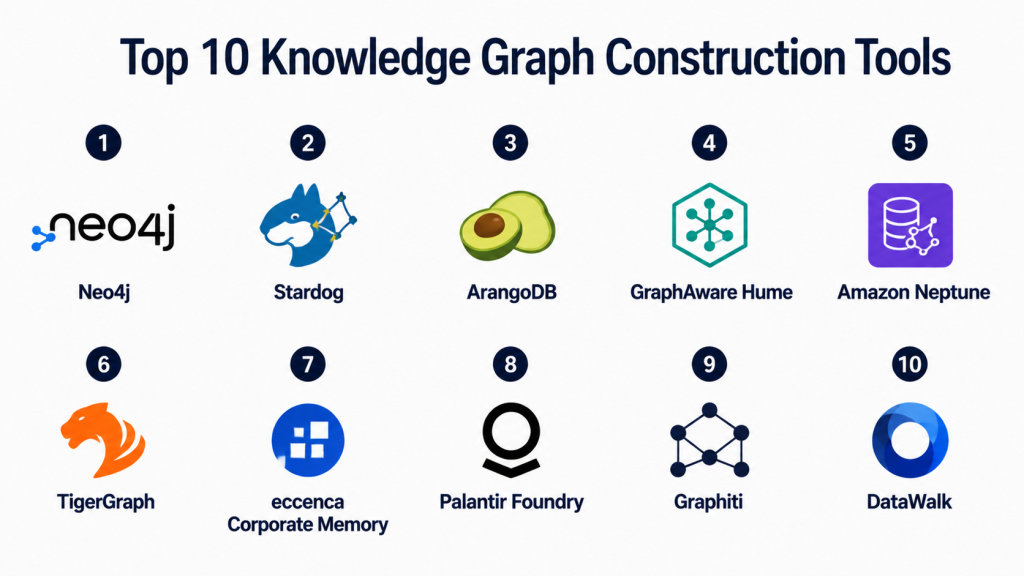
Top 10 Knowledge Graph Construction Tools
1- Neo4j
One-line verdict: Best for enterprise-grade graph databases with mature knowledge graph and GraphRAG ecosystems.
Short description:
Neo4j is one of the most widely adopted graph database and knowledge graph platforms used for semantic relationships, GraphRAG, fraud analysis, recommendation systems, and enterprise AI applications.
It provides strong graph traversal, graph analytics, and graph querying capabilities.
The platform has a mature ecosystem with extensive developer tooling and integrations.
It is widely used for production-scale knowledge graph construction workloads.
Standout Capabilities
- Mature graph database ecosystem
- Cypher graph query language
- GraphRAG workflows
- Multi-hop relationship traversal
- Graph analytics and graph science
- Enterprise scalability
- AI and vector integration support
- Strong developer tooling
AI-Specific Depth
- Model support: Open source, proprietary, and BYO model workflows
- RAG and knowledge integration: Strong GraphRAG compatibility
- Evaluation: Graph analytics and retrieval workflows available
- Guardrails: Enterprise governance support varies by deployment
- Observability: Graph analytics and monitoring support available
Pros
- Strong graph ecosystem
- Excellent relationship querying
- Mature enterprise tooling
Cons
- Can become operationally complex
- Enterprise licensing may be expensive
- Advanced graph modeling requires expertise
Security and Compliance
RBAC, encryption, SSO, audit capabilities, and enterprise governance features are available depending on deployment and subscription.
Deployment and Platforms
- Cloud
- Self hosted
- Kubernetes
- Linux infrastructure
- Enterprise server deployment
Integrations and Ecosystem
- LangChain
- GraphRAG workflows
- Vector databases
- AI orchestration systems
- Enterprise data pipelines
- Graph analytics tools
Pricing Model
Open source core with enterprise subscription and managed cloud pricing.
Best-Fit Scenarios
- Enterprise knowledge graphs
- Fraud detection systems
- AI copilots
- GraphRAG workflows
- Semantic enterprise search
2- Stardog
One-line verdict: Best for ontology-driven enterprise knowledge graphs with semantic reasoning capabilities.
Short description:
Stardog is an enterprise knowledge graph platform focused on semantic modeling, ontology management, and reasoning.
It supports RDF, OWL reasoning, and semantic data virtualization workflows.
The platform is commonly used in enterprise semantic infrastructure and AI-ready data architectures.
It is especially strong for organizations requiring governed semantic reasoning.
Standout Capabilities
- RDF and OWL support
- Ontology-driven modeling
- Semantic reasoning
- Virtual graph integration
- Enterprise semantic layer
- AI-ready graph infrastructure
- Multi-source data federation
- Graph query optimization
AI-Specific Depth
- Model support: External AI and embedding workflows
- RAG and knowledge integration: Strong GraphRAG compatibility
- Evaluation: Semantic validation workflows available
- Guardrails: Governance and ontology controls available
- Observability: Query monitoring and lineage tracking available
Pros
- Strong semantic modeling
- Excellent ontology support
- Enterprise governance focus
Cons
- Steeper learning curve
- Enterprise-oriented pricing
- Requires semantic web expertise
Security and Compliance
RBAC, governance controls, semantic lineage, encryption, and enterprise access management are available depending on deployment.
Deployment and Platforms
- Cloud
- On-premise
- Hybrid deployment
- Kubernetes support
- Enterprise infrastructure
Integrations and Ecosystem
- Enterprise semantic systems
- AI retrieval workflows
- RDF tooling
- Data virtualization pipelines
- Knowledge graph analytics
Pricing Model
Enterprise licensing and marketplace-based deployment pricing.
Best-Fit Scenarios
- Enterprise semantic infrastructure
- Ontology-driven AI
- Governed enterprise knowledge graphs
- Semantic interoperability
- Explainable AI systems
3- ArangoDB
One-line verdict: Best for multi-model graph and vector workloads inside unified AI architectures.
Short description:
ArangoDB is a multi-model database supporting graph, document, key-value, and vector workflows in one platform.
It is increasingly used for GraphRAG architectures and AI-native semantic applications.
The platform provides flexibility for organizations wanting graph and vector retrieval in one stack.
It works well for AI applications combining semantic search and graph reasoning.
Standout Capabilities
- Multi-model architecture
- Graph and vector support
- Flexible graph querying
- Distributed scalability
- Graph analytics workflows
- AI-native retrieval support
- Unified data model
- GraphRAG compatibility
AI-Specific Depth
- Model support: Open source and BYO AI workflows
- RAG and knowledge integration: Strong GraphRAG support
- Evaluation: Varies / N/A
- Guardrails: Governance varies by deployment
- Observability: Metrics and monitoring available
Pros
- Flexible multi-model design
- Strong GraphRAG fit
- Good scalability support
Cons
- Smaller ecosystem than Neo4j
- Enterprise tooling maturity varies
- Advanced optimization may require expertise
Security and Compliance
Authentication, RBAC, encryption, and enterprise controls depend on deployment and subscription.
Deployment and Platforms
- Cloud
- Self hosted
- Kubernetes
- Linux infrastructure
- Distributed deployment
Integrations and Ecosystem
- AI orchestration frameworks
- Graph analytics workflows
- Vector retrieval systems
- Enterprise AI pipelines
- GraphRAG architectures
Pricing Model
Open source plus enterprise subscription pricing.
Best-Fit Scenarios
- GraphRAG systems
- Multi-model AI platforms
- Semantic retrieval
- Enterprise graph analytics
- AI-native applications
4- GraphAware Hume
One-line verdict: Best for automated enterprise knowledge graph extraction and NLP-driven relationship discovery.
Short description:
GraphAware Hume is a graph-powered knowledge graph platform focused on NLP, entity extraction, and automated graph construction.
It helps enterprises transform unstructured data into connected semantic knowledge graphs.
The platform supports contextual intelligence, graph analytics, and relationship discovery workflows.
It is commonly used in intelligence, compliance, and enterprise AI systems.
Standout Capabilities
- NLP-driven graph extraction
- Automated entity recognition
- Relationship discovery
- Enterprise graph analytics
- Unstructured data ingestion
- AI-powered graph enrichment
- Contextual intelligence workflows
- Graph visualization support
AI-Specific Depth
- Model support: NLP and external embedding integrations
- RAG and knowledge integration: Strong graph retrieval workflows
- Evaluation: Entity extraction analytics available
- Guardrails: Enterprise governance workflows available
- Observability: Monitoring and graph analytics support
Pros
- Strong NLP graph extraction
- Useful for unstructured data
- Good contextual intelligence workflows
Cons
- Enterprise-oriented onboarding
- Smaller developer ecosystem
- Pricing may be enterprise-focused
Security and Compliance
Enterprise governance, access controls, encryption, and security policies vary by deployment.
Deployment and Platforms
- Cloud
- Enterprise deployment
- API integrations
- Hybrid workflows
- Linux infrastructure
Integrations and Ecosystem
- NLP pipelines
- Enterprise data systems
- AI workflows
- Knowledge graph analytics
- Search systems
Pricing Model
Enterprise subscription pricing depending on deployment scale.
Best-Fit Scenarios
- Enterprise entity extraction
- Intelligence analysis
- AI knowledge systems
- Compliance workflows
- Relationship analytics
5- Amazon Neptune
One-line verdict: Best for scalable managed graph databases inside AWS enterprise environments.
Short description:
Amazon Neptune is a managed graph database service supporting property graphs and semantic RDF workloads.
It is designed for enterprise-scale graph applications inside AWS cloud infrastructure.
The platform supports graph traversal, semantic relationships, and AI-driven graph applications.
It works well for organizations already invested in AWS ecosystems.
Standout Capabilities
- Managed graph database
- RDF and property graph support
- AWS ecosystem integration
- Scalable graph processing
- Graph analytics support
- Semantic querying
- AI workflow compatibility
- Enterprise cloud governance
AI-Specific Depth
- Model support: External embeddings and AI integrations
- RAG and knowledge integration: GraphRAG compatibility supported
- Evaluation: Varies / N/A
- Guardrails: AWS governance workflows available
- Observability: Cloud monitoring integrations available
Pros
- Strong AWS integration
- Managed infrastructure simplicity
- Good enterprise scalability
Cons
- AWS dependency
- Vendor lock in concerns
- Advanced semantic workflows may need customization
Security and Compliance
IAM, encryption, audit logging, network controls, and AWS governance integrations are available depending on deployment.
Deployment and Platforms
- Cloud
- AWS managed infrastructure
- API access
- Enterprise cloud workflows
Integrations and Ecosystem
- AWS services
- AI orchestration systems
- Graph analytics
- Enterprise pipelines
- Retrieval workflows
Pricing Model
Cloud usage pricing based on storage, compute, and query workloads.
Best-Fit Scenarios
- AWS enterprise AI
- Graph analytics
- Semantic enterprise retrieval
- AI-driven graph applications
- Enterprise knowledge systems
6- TigerGraph
One-line verdict: Best for high-performance graph analytics and real-time relationship intelligence.
Short description:
TigerGraph is a graph analytics platform optimized for large-scale relationship analysis and real-time graph processing.
It is widely used in fraud detection, cybersecurity, telecom intelligence, and customer analytics.
The platform emphasizes graph performance and real-time analytics at enterprise scale.
It works well for operational intelligence and graph-heavy workloads.
Standout Capabilities
- High-performance graph analytics
- Real-time graph processing
- Distributed graph architecture
- Fraud and risk analysis support
- Large-scale graph traversal
- AI workflow compatibility
- Graph visualization support
- Enterprise scalability
AI-Specific Depth
- Model support: External AI workflows and embeddings
- RAG and knowledge integration: Graph retrieval support available
- Evaluation: Graph analytics evaluation workflows
- Guardrails: Enterprise governance controls vary
- Observability: Monitoring and analytics support available
Pros
- Excellent graph performance
- Strong real-time analytics
- Good for large-scale relationship analysis
Cons
- Enterprise-focused complexity
- Requires graph expertise
- Smaller ecosystem than Neo4j
Security and Compliance
Enterprise RBAC, encryption, governance, and security controls vary depending on deployment and subscription.
Deployment and Platforms
- Cloud
- Self hosted
- Enterprise deployment
- Distributed infrastructure
- Kubernetes support
Integrations and Ecosystem
- Graph analytics systems
- AI workflows
- Enterprise intelligence systems
- Fraud detection pipelines
- Relationship analytics
Pricing Model
Enterprise subscription pricing.
Best-Fit Scenarios
- Fraud detection
- Cybersecurity analytics
- Customer intelligence
- Real-time relationship analytics
- Large graph workloads
7- eccenca Corporate Memory
One-line verdict: Best for enterprise semantic data integration and ontology management workflows.
Short description:
eccenca Corporate Memory is a semantic knowledge graph platform designed for enterprise data integration and ontology-driven workflows.
It focuses heavily on semantic interoperability, linked data, and governance-driven graph construction.
The platform is useful for organizations building semantic enterprise infrastructure.
It works well for governed AI and semantic interoperability use cases.
Standout Capabilities
- Ontology management
- Semantic interoperability
- Linked data workflows
- Enterprise semantic integration
- RDF and semantic web support
- Data governance workflows
- AI-ready graph architectures
- Semantic lineage support
AI-Specific Depth
- Model support: External AI integrations
- RAG and knowledge integration: Strong semantic retrieval compatibility
- Evaluation: Semantic validation workflows available
- Guardrails: Governance and ontology controls available
- Observability: Lineage and semantic monitoring support
Pros
- Strong semantic interoperability
- Good ontology tooling
- Enterprise governance support
Cons
- Requires semantic web expertise
- Smaller ecosystem
- Enterprise onboarding complexity
Security and Compliance
Enterprise governance, RBAC, semantic lineage, encryption, and security workflows vary depending on deployment.
Deployment and Platforms
- Cloud
- Self hosted
- Enterprise deployment
- Hybrid workflows
- Semantic infrastructure support
Integrations and Ecosystem
- RDF systems
- Semantic web tooling
- Enterprise AI workflows
- Graph analytics
- Data governance systems
Pricing Model
Enterprise subscription pricing.
Best-Fit Scenarios
- Semantic enterprise infrastructure
- Ontology-driven AI
- Data interoperability
- Governed semantic retrieval
- Enterprise semantic integration
8- Palantir Foundry
One-line verdict: Best for operational enterprise knowledge graphs inside regulated industries.
Short description:
Palantir Foundry combines ontology-driven enterprise modeling with operational analytics and AI workflows.
It is heavily used in government, defense, healthcare, and regulated enterprise environments.
The platform supports operational knowledge graphs connected directly to workflows and decision systems.
It works well for complex regulated environments needing AI and operational integration.
Standout Capabilities
- Ontology-driven enterprise modeling
- Operational graph workflows
- AI integration support
- Enterprise analytics
- Workflow orchestration
- Governance and lineage tracking
- Large-scale enterprise integration
- Regulated environment support
AI-Specific Depth
- Model support: Enterprise AI integrations
- RAG and knowledge integration: GraphRAG-compatible architectures supported
- Evaluation: Workflow analytics and operational evaluation support
- Guardrails: Strong enterprise governance workflows
- Observability: Enterprise lineage and operational monitoring
Pros
- Strong operational integration
- Excellent governance capabilities
- Useful for regulated industries
Cons
- Enterprise complexity
- High onboarding effort
- Expensive enterprise deployments
Security and Compliance
Enterprise-grade governance, auditability, encryption, RBAC, lineage, and operational controls are core platform capabilities.
Deployment and Platforms
- Cloud
- On-premise
- Hybrid deployment
- Enterprise infrastructure
- Government deployment support
Integrations and Ecosystem
- Enterprise operational systems
- AI workflows
- Data governance systems
- Analytics infrastructure
- Operational intelligence platforms
Pricing Model
Enterprise licensing and deployment pricing.
Best-Fit Scenarios
- Government AI systems
- Healthcare intelligence
- Operational AI
- Regulated enterprise analytics
- Enterprise semantic infrastructure
9- Graphiti
One-line verdict: Best for real-time AI agent memory graphs and temporal knowledge tracking.
Short description:
Graphiti is an open-source framework designed for temporal context graphs and AI agent memory systems.
Unlike static knowledge graphs, it tracks changing facts, provenance, and evolving relationships over time.
It is purpose-built for AI agents operating in dynamic environments.
It works well for contextual memory and agent reasoning systems.
Standout Capabilities
- Temporal context graphs
- AI agent memory support
- Provenance tracking
- Dynamic relationship management
- MCP compatibility
- Real-time graph updates
- AI-native graph workflows
- Open-source ecosystem
AI-Specific Depth
- Model support: Open-source and BYO model workflows
- RAG and knowledge integration: Strong AI agent compatibility
- Evaluation: Context and provenance tracking workflows available
- Guardrails: Varies / N/A
- Observability: Temporal graph monitoring available
Pros
- Purpose-built for AI agents
- Strong temporal graph support
- Open-source flexibility
Cons
- Smaller ecosystem
- Early-stage enterprise maturity
- Advanced deployment may require expertise
Security and Compliance
Security controls depend on deployment architecture and infrastructure setup.
Deployment and Platforms
- Open-source deployment
- Self hosted
- Linux infrastructure
- API workflows
- AI agent integrations
Integrations and Ecosystem
- MCP systems
- AI agent frameworks
- Graph workflows
- Temporal retrieval systems
- Open-source AI infrastructure
Pricing Model
Open-source with infrastructure-based deployment costs.
Best-Fit Scenarios
- AI agent memory
- Temporal graph systems
- Dynamic contextual retrieval
- AI-native semantic memory
- Agent reasoning workflows
10- DataWalk
One-line verdict: Best for investigative intelligence and entity relationship analysis at enterprise scale.
Short description:
DataWalk is a graph intelligence platform focused on investigations, fraud analysis, AML, and relationship analytics.
It combines graph visualization, entity resolution, and operational intelligence workflows.
The platform is widely used in financial intelligence and investigative environments.
It works well for large-scale relationship-centric intelligence analysis.
Standout Capabilities
- Entity resolution workflows
- Fraud and AML analytics
- Relationship intelligence
- Graph visualization
- Investigative workflows
- Large-scale graph analytics
- Operational intelligence support
- Multi-source data integration
AI-Specific Depth
- Model support: External AI integrations
- RAG and knowledge integration: Graph analytics compatibility available
- Evaluation: Investigative analytics workflows supported
- Guardrails: Enterprise governance and audit workflows available
- Observability: Operational monitoring and analytics available
Pros
- Excellent investigative analytics
- Strong entity resolution
- Good graph visualization workflows
Cons
- Enterprise-focused complexity
- Smaller developer ecosystem
- Limited open-source flexibility
Security and Compliance
Enterprise RBAC, audit workflows, encryption, governance, and operational controls vary depending on deployment.
Deployment and Platforms
- Cloud
- On-premise
- Enterprise deployment
- Government and regulated infrastructure support
Integrations and Ecosystem
- Fraud analytics systems
- Financial intelligence workflows
- Investigation pipelines
- Entity resolution systems
- Enterprise analytics tools
Pricing Model
Enterprise licensing and deployment pricing.
Best-Fit Scenarios
- Fraud detection
- AML investigations
- Intelligence analysis
- Relationship analytics
- Enterprise graph intelligence
Comparison Table
| Tool | Best For | Deployment | Key Strength | Pricing Model | Ideal Buyer |
|---|---|---|---|---|---|
| Neo4j | Enterprise knowledge graphs | Cloud and self hosted | Mature graph ecosystem | Open source plus enterprise | Enterprise AI teams |
| Stardog | Semantic ontology modeling | Cloud and hybrid | OWL reasoning | Enterprise licensing | Semantic web teams |
| ArangoDB | Multi-model GraphRAG | Cloud and self hosted | Graph plus vector workflows | Open source plus enterprise | AI platform teams |
| GraphAware Hume | NLP-driven graph extraction | Cloud and enterprise | Automated relationship discovery | Enterprise subscription | Intelligence teams |
| Amazon Neptune | AWS graph infrastructure | Cloud | Managed graph database | Cloud usage pricing | AWS enterprise teams |
| TigerGraph | Real-time graph analytics | Cloud and self hosted | Graph performance | Enterprise subscription | Fraud analytics teams |
| eccenca Corporate Memory | Semantic interoperability | Cloud and self hosted | Ontology workflows | Enterprise subscription | Governance teams |
| Palantir Foundry | Operational enterprise graphs | Cloud and hybrid | Operational ontology systems | Enterprise licensing | Regulated enterprises |
| Graphiti | AI agent memory graphs | Open-source self hosted | Temporal graph memory | Infrastructure costs | AI agent developers |
| DataWalk | Investigative intelligence | Cloud and on-premise | Entity relationship analysis | Enterprise licensing | Financial intelligence teams |
Scoring and Evaluation Table
| Tool | Graph Modeling | AI Integration | Scalability | Governance | Observability | Ease of Use | Value | Weighted Total |
|---|---|---|---|---|---|---|---|---|
| Neo4j | 9 | 9 | 9 | 8 | 8 | 7 | 8 | 8.3 |
| Stardog | 9 | 8 | 8 | 9 | 8 | 6 | 7 | 7.9 |
| ArangoDB | 8 | 8 | 8 | 7 | 7 | 7 | 8 | 7.6 |
| GraphAware Hume | 8 | 8 | 7 | 8 | 7 | 6 | 7 | 7.3 |
| Amazon Neptune | 8 | 7 | 9 | 8 | 8 | 7 | 7 | 7.7 |
| TigerGraph | 9 | 7 | 9 | 8 | 7 | 6 | 7 | 7.6 |
| eccenca Corporate Memory | 8 | 7 | 7 | 9 | 8 | 6 | 7 | 7.4 |
| Palantir Foundry | 9 | 9 | 9 | 10 | 9 | 5 | 6 | 8.1 |
| Graphiti | 7 | 9 | 7 | 6 | 7 | 7 | 8 | 7.3 |
| DataWalk | 8 | 7 | 8 | 8 | 8 | 6 | 7 | 7.4 |
Top 3 Tools for Enterprise
1- Neo4j
Best for enterprises needing mature graph infrastructure, GraphRAG workflows, and scalable semantic relationship analysis.
2- Stardog
Best for organizations focused on semantic governance, ontology management, and explainable AI reasoning.
3- Palantir Foundry
Best for operational enterprise AI systems in regulated and governance-heavy industries.
Top 3 Tools for SMB
1- ArangoDB
Best for SMB teams wanting graph plus vector capabilities in one flexible platform.
2- Neo4j
Best for SMB teams needing mature graph tooling and a large developer ecosystem.
3- Graphiti
Best for AI-native startups building contextual memory and AI agent reasoning systems.
Top 3 Tools for Developers
1- Neo4j
Best for developers building GraphRAG systems and graph-powered applications.
2- Graphiti
Best for developers building AI agent memory systems and temporal graph workflows.
3- ArangoDB
Best for developers wanting multi-model graph and vector retrieval flexibility.
Which Tool Is Right for You
For enterprise semantic infrastructure
Choose Stardog or eccenca Corporate Memory if ontology governance and semantic interoperability are your highest priorities.
For GraphRAG and AI retrieval
Choose Neo4j or ArangoDB when combining graph traversal with vector retrieval and AI workflows.
For operational intelligence
Choose Palantir Foundry or DataWalk when graphs must connect directly to operational analytics and investigative workflows.
For AWS-native graph systems
Choose Amazon Neptune if your organization already depends heavily on AWS infrastructure and governance workflows.
For graph analytics performance
Choose TigerGraph when graph traversal speed and relationship analytics are mission critical.
For AI agent memory systems
Choose Graphiti when building temporal AI memory and dynamic contextual graph workflows.
For automated graph extraction
Choose GraphAware Hume if entity extraction and relationship discovery from unstructured data are key requirements.
Implementation Playbook
First 30 Days
- Define graph construction use cases
- Identify core entities and relationships
- Select ontology and schema strategies
- Pilot three graph platforms
- Build small graph ingestion workflows
- Benchmark graph traversal performance
- Test semantic retrieval quality
Next 60 Days
- Integrate graph systems with AI workflows
- Add entity resolution pipelines
- Implement metadata and governance rules
- Build graph observability dashboards
- Test GraphRAG workflows
- Add relationship enrichment logic
- Benchmark multi-hop query performance
Next 90 Days
- Scale graph ingestion pipelines
- Add real-time graph updates
- Implement RBAC and audit logging
- Optimize graph traversal latency
- Finalize production graph schema
- Validate AI reasoning quality
- Build backup and graph migration workflows
Common Mistakes and How to Avoid Them
1- Building graphs without clear ontology design
Poor ontology planning creates inconsistent graphs and weak semantic reasoning.
2- Ignoring entity resolution
Duplicate or fragmented entities reduce graph quality and AI accuracy.
3- Overcomplicating graph schemas early
Start with a focused schema and expand gradually instead of modeling everything immediately.
4- Skipping graph evaluation
Teams need test queries and expected graph reasoning paths to validate graph quality.
5- Ignoring graph observability
Graph systems need query analytics, lineage tracking, and traversal monitoring.
6- Treating vector search and graphs as separate systems
Modern GraphRAG workflows often require vector retrieval plus graph traversal together.
7- Weak governance controls
Graphs can expose sensitive relationships if RBAC and access policies are missing.
8- Underestimating graph scale complexity
Relationship-heavy workloads can grow rapidly and require careful architecture planning.
9- Choosing tools only by popularity
A popular graph database may not fit your ontology, reasoning, or governance requirements.
10- Ignoring provenance tracking
Without provenance and lineage, AI explainability and auditability become difficult.
Frequently Asked Questions
1- What are Knowledge Graph Construction Tools?
Knowledge Graph Construction Tools help organizations create semantic graphs that connect entities, relationships, and contextual information into machine-readable structures.
2- Why are knowledge graphs important for AI?
Knowledge graphs improve explainability, reasoning, contextual understanding, and multi-hop relationship retrieval for AI systems.
3- What is GraphRAG?
GraphRAG combines knowledge graph traversal with retrieval augmented generation to improve AI retrieval quality and reduce hallucinations.
4- Which tool is best for enterprise knowledge graphs?
Neo4j, Stardog, and Palantir Foundry are strong enterprise choices depending on governance and operational requirements.
5- Which tool is best for developers?
Neo4j, Graphiti, and ArangoDB are popular because they provide strong developer flexibility and AI-native workflows.
6- Why is ontology modeling important?
Ontology modeling defines entities, relationships, categories, and rules that help AI systems understand semantic meaning consistently.
7- What is entity resolution in knowledge graphs?
Entity resolution identifies and merges duplicate or related entities across multiple systems and datasets.
8- Why are graphs useful for AI agents?
Graphs provide structured contextual memory and relationship reasoning that help AI agents make more accurate decisions.
9- What is the biggest challenge in knowledge graph construction?
Balancing ontology complexity, graph scalability, governance, explainability, and real-time updates is usually the biggest challenge.
10- How should teams evaluate knowledge graph quality?
Teams should test entity accuracy, relationship quality, graph traversal performance, semantic consistency, retrieval relevance, and AI reasoning outcomes.
Conclusion
Knowledge Graph Construction Tools are becoming a critical foundation for modern AI infrastructure. They help organizations connect fragmented enterprise data, improve semantic understanding, support GraphRAG systems, and enable explainable AI reasoning. As AI agents, retrieval augmented generation, and semantic enterprise applications become more advanced, graph-driven contextual intelligence is becoming increasingly important.The best platform depends on your governance requirements, graph complexity, AI maturity, and deployment strategy. Neo4j remains a leading platform for enterprise graph workloads, while Stardog and eccenca Corporate Memory are strong for ontology-driven semantic infrastructure. ArangoDB and Graphiti are excellent for AI-native graph systems, while Palantir Foundry and DataWalk excel in operational intelligence environments. The smartest next step is to shortlist three platforms, build a pilot graph using real enterprise data, benchmark graph traversal and AI retrieval quality, then scale gradually with strong governance and observability practices.

Find Trusted Cardiac Hospitals
Compare heart hospitals by city and services — all in one place.
Explore Hospitals
What’s missing here is the real production challenge of maintaining knowledge graphs beyond initial construction, especially how quickly they become inconsistent when underlying data sources change schema, structure, or ownership. In practice, the hardest problem isn’t building the graph but ensuring entity resolution accuracy and continuous relationship validation as new data streams are added over time. The article also doesn’t address incremental graph updates vs full rebuild trade-offs, which can heavily impact cost and latency at scale, nor the challenge of governance and lineage tracking, where teams need to know not just what is connected, but why a relationship exists and whether it is still valid in a live system.