
Introduction
Ontology Management Tools for AI help organizations define, structure, govern, and manage semantic meaning across enterprise systems, AI models, knowledge graphs, and data ecosystems. In simple terms, ontologies define what concepts mean, how entities relate to one another, and which rules govern those relationships. These tools create a shared semantic foundation that allows AI systems, agents, analytics platforms, and humans to understand business context consistently.
Ontology management has become increasingly important because modern AI systems require more than raw data and embeddings. AI copilots, GraphRAG architectures, semantic search engines, enterprise knowledge assistants, AI agents, and compliance workflows all depend on structured semantic understanding. Ontologies improve explainability, reduce ambiguity, strengthen governance, and help AI systems reason over trusted enterprise knowledge.
Why It Matters
- Improves AI explainability and reasoning
- Enables GraphRAG and semantic retrieval workflows
- Standardizes enterprise terminology
- Reduces ambiguity across systems and teams
- Supports AI governance and compliance
- Improves contextual understanding for AI agents
Real-World Use Cases
- Enterprise semantic search
- AI copilots and AI agents
- Knowledge graph construction
- Data governance workflows
- Healthcare semantic interoperability
- Financial compliance intelligence
- Customer 360 semantic modeling
- Semantic enterprise analytics
Evaluation Criteria for Buyers
- Ontology modeling depth
- RDF and OWL standards support
- Semantic reasoning capabilities
- AI and GraphRAG integration support
- Governance and lineage controls
- Scalability and performance
- Multi-source data integration
- Collaboration workflows
- Visualization and graph analytics
- Deployment flexibility
- Query and API support
- Vendor lock in risk
Best for: Enterprise AI teams, semantic web engineers, data governance teams, AI architects, GraphRAG developers, compliance teams, healthcare organizations, and enterprises building AI-ready semantic infrastructure.
Not ideal for: Small applications with simple relational data, lightweight search-only systems, or teams without semantic modeling and governance requirements.
What’s Changed in Ontology Management Tools for AI
- GraphRAG architectures are driving ontology adoption across enterprise AI systems
- AI agents increasingly require ontology-grounded reasoning and contextual memory
- Ontology-first architectures are replacing schema-first enterprise AI workflows
- Semantic interoperability is becoming critical for regulated industries
- LLM-driven ontology generation is accelerating semantic modeling workflows
- Enterprises now demand provenance-aware semantic retrieval and auditability
- Hybrid vector plus ontology retrieval systems are becoming standard AI architectures
- Semantic governance is becoming essential for AI compliance initiatives
- Real-time ontology updates are replacing static semantic layers
- Enterprise semantic layers are increasingly integrated with AI orchestration systems
- Ontology-aware tool calling is emerging for AI agent systems
- Open-source ontology ecosystems are growing rapidly in enterprise AI infrastructure
Quick Buyer Checklist
- Does the platform support RDF, OWL, and SPARQL
- Can it integrate with AI and GraphRAG workflows
- Does it support ontology versioning and governance
- Can it handle enterprise-scale semantic modeling
- Does it support semantic reasoning and inference
- Are lineage and provenance features available
- Does it integrate with vector search systems
- Can multiple teams collaborate on ontology development
- Does it support cloud and self hosted deployment
- Are RBAC and audit workflows available
- Can it integrate with existing enterprise systems
- Is migration possible without major rework
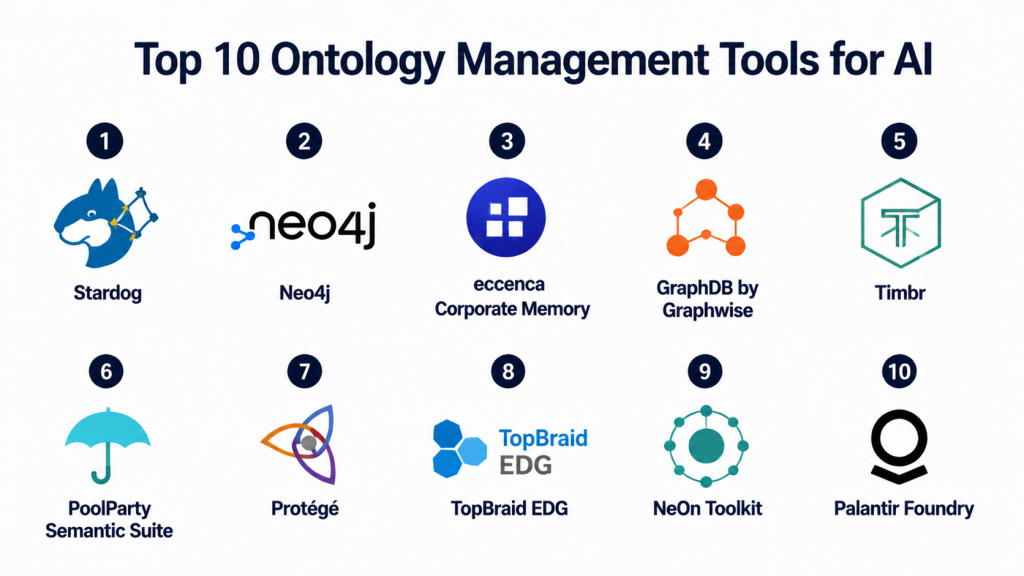
Top 10 Ontology Management Tools for AI
1- Stardog
One-line verdict: Best for enterprise ontology governance with strong semantic reasoning and GraphRAG readiness.
Short description:
Stardog is an enterprise semantic graph and ontology management platform focused on semantic modeling, RDF workflows, and ontology-driven AI infrastructure.
It provides OWL reasoning, virtual graph integration, semantic validation, and AI-ready semantic architectures.
The platform is widely used for enterprise semantic interoperability and explainable AI systems.
It is one of the strongest enterprise ontology platforms for regulated and governance-heavy environments.
Standout Capabilities
- RDF and OWL ontology support
- SPARQL semantic querying
- Semantic reasoning engine
- Virtual graph integration
- Ontology governance workflows
- Enterprise semantic interoperability
- GraphRAG compatibility
- Semantic validation support
AI-Specific Depth
- Model support: Open-source, proprietary, and BYO AI workflows
- RAG and knowledge integration: Strong GraphRAG and semantic retrieval support
- Evaluation: Semantic validation and ontology reasoning workflows available
- Guardrails: Governance and ontology policy controls available
- Observability: Query monitoring and lineage tracking available
Pros
- Excellent semantic standards support
- Strong ontology governance capabilities
- Useful for explainable enterprise AI
Cons
- Requires semantic web expertise
- Enterprise-focused pricing
- Steeper learning curve for beginners
Security and Compliance
RBAC, audit logging, semantic lineage, encryption, and enterprise governance controls are available depending on deployment and subscription.
Deployment and Platforms
- Cloud
- On-premise
- Hybrid deployment
- Kubernetes support
- Enterprise infrastructure
Integrations and Ecosystem
- GraphRAG workflows
- RDF tooling
- AI orchestration systems
- Enterprise semantic pipelines
- Knowledge graph systems
- Data governance workflows
Pricing Model
Enterprise subscription and deployment pricing.
Best-Fit Scenarios
- Enterprise semantic infrastructure
- GraphRAG systems
- Ontology-driven AI
- Explainable AI workflows
- Semantic interoperability
2- Neo4j
One-line verdict: Best for graph-driven ontology management combined with enterprise knowledge graph workflows.
Short description:
Neo4j is a graph database and semantic relationship platform widely used for knowledge graphs, GraphRAG, semantic retrieval, and ontology-driven AI applications.
While not a pure ontology management system, it integrates strongly with semantic graph architectures and ontology workflows.
The platform supports enterprise graph analytics and AI-ready relationship modeling.
It is highly popular among AI engineering and knowledge graph teams.
Standout Capabilities
- Graph database architecture
- Relationship-centric semantic modeling
- Graph analytics workflows
- GraphRAG compatibility
- Cypher query language
- Enterprise scalability
- AI-native graph retrieval
- Visualization and traversal support
AI-Specific Depth
- Model support: BYO embeddings and AI integrations
- RAG and knowledge integration: Strong GraphRAG support
- Evaluation: Graph analytics workflows available
- Guardrails: Enterprise governance varies by deployment
- Observability: Graph analytics and monitoring support available
Pros
- Strong graph ecosystem
- Excellent relationship traversal
- Large developer community
Cons
- Ontology workflows may require extensions
- Advanced semantic standards support varies
- Enterprise deployments can become complex
Security and Compliance
RBAC, encryption, SSO, and enterprise governance controls vary depending on deployment and subscription.
Deployment and Platforms
- Cloud
- Self hosted
- Kubernetes
- Enterprise server deployment
- Linux infrastructure
Integrations and Ecosystem
- LangChain
- LlamaIndex
- GraphRAG systems
- AI orchestration frameworks
- Knowledge graph workflows
- Graph analytics systems
Pricing Model
Open-source core with enterprise and managed cloud pricing.
Best-Fit Scenarios
- Enterprise knowledge graphs
- GraphRAG systems
- AI relationship reasoning
- Semantic enterprise search
- AI copilots
3- eccenca Corporate Memory
One-line verdict: Best for governed enterprise ontology and semantic interoperability workflows.
Short description:
eccenca Corporate Memory is a semantic knowledge graph and ontology management platform designed for enterprise semantic integration and governance.
It focuses heavily on ontology management, linked data workflows, semantic lineage, and interoperability.
The platform is commonly used in regulated industries and governance-heavy environments.
It is well suited for enterprise semantic infrastructure projects.
Standout Capabilities
- Ontology lifecycle management
- Semantic interoperability support
- RDF and linked data workflows
- Semantic lineage tracking
- Governance-driven modeling
- Enterprise semantic integration
- AI-ready semantic architectures
- Data catalog compatibility
AI-Specific Depth
- Model support: External AI and embedding integrations
- RAG and knowledge integration: GraphRAG compatibility available
- Evaluation: Semantic validation workflows supported
- Guardrails: Governance and ontology policies available
- Observability: Lineage and semantic monitoring support available
Pros
- Strong governance workflows
- Excellent semantic interoperability support
- Useful ontology lifecycle management
Cons
- Smaller developer ecosystem
- Requires semantic expertise
- Enterprise onboarding complexity
Security and Compliance
RBAC, lineage tracking, encryption, governance workflows, and semantic audit controls vary by deployment.
Deployment and Platforms
- Cloud
- Self hosted
- Enterprise deployment
- Hybrid workflows
- Semantic infrastructure environments
Integrations and Ecosystem
- RDF tooling
- Semantic web systems
- AI retrieval workflows
- Enterprise governance systems
- Graph analytics platforms
Pricing Model
Enterprise subscription pricing.
Best-Fit Scenarios
- Semantic governance
- Ontology-driven AI
- Enterprise interoperability
- Knowledge graph infrastructure
- Governed GraphRAG workflows
4- GraphDB by Graphwise
One-line verdict: Best for semantic graph infrastructure with enterprise AI trust and precision workflows.
Short description:
GraphDB by Graphwise is a semantic graph platform focused on enterprise AI grounding, semantic precision, and trusted knowledge infrastructure.
The platform combines semantic graph technologies, ontology workflows, and AI governance support.
It is widely used in semantic enterprise search and AI-ready graph architectures.
It works well for organizations building trusted AI systems.
Standout Capabilities
- Semantic graph infrastructure
- Ontology and RDF support
- GraphRAG compatibility
- AI grounding workflows
- Semantic enterprise search
- Trusted semantic backbone
- Enterprise AI governance
- Semantic graph analytics
AI-Specific Depth
- Model support: BYO AI and semantic retrieval workflows
- RAG and knowledge integration: Strong GraphRAG support
- Evaluation: Semantic reasoning and graph validation available
- Guardrails: Governance and semantic policy workflows supported
- Observability: Semantic monitoring and graph analytics available
Pros
- Strong semantic graph capabilities
- Good enterprise AI support
- Useful governance tooling
Cons
- Enterprise-focused complexity
- Requires semantic graph expertise
- Advanced onboarding requirements
Security and Compliance
Enterprise governance, RBAC, encryption, and audit controls vary depending on deployment and subscription.
Deployment and Platforms
- Cloud
- Enterprise deployment
- Hybrid workflows
- Semantic infrastructure environments
- API integrations
Integrations and Ecosystem
- Semantic web tooling
- AI orchestration frameworks
- Graph analytics workflows
- Knowledge graph systems
- Enterprise semantic infrastructure
Pricing Model
Enterprise licensing and deployment pricing.
Best-Fit Scenarios
- Trusted enterprise AI
- Semantic enterprise search
- GraphRAG infrastructure
- AI grounding systems
- Knowledge graph analytics
5- Timbr
One-line verdict: Best for SQL-native ontology management and semantic layers for enterprise AI.
Short description:
Timbr is an ontology-based semantic layer platform focused on enterprise AI, semantic virtualization, and SQL-native ontology modeling.
It allows organizations to create semantic ontologies across distributed systems without moving data.
The platform emphasizes governance, semantic abstraction, and AI-ready data foundations.
It is useful for enterprises modernizing semantic data architectures.
Standout Capabilities
- SQL-native ontology modeling
- Ontology-based semantic layer
- Data virtualization support
- Federated semantic logic
- GraphRAG compatibility
- Enterprise AI data foundation
- Access control and governance
- Query optimization workflows
AI-Specific Depth
- Model support: External AI and semantic retrieval workflows
- RAG and knowledge integration: GraphRAG and semantic retrieval support
- Evaluation: Semantic validation and logic workflows available
- Guardrails: Governance and semantic policy controls available
- Observability: Semantic layer analytics and monitoring supported
Pros
- Strong SQL ecosystem integration
- Good semantic abstraction workflows
- Useful enterprise AI foundation support
Cons
- Smaller ecosystem than larger vendors
- Requires semantic architecture planning
- Enterprise deployment complexity varies
Security and Compliance
Access control, governance workflows, semantic lineage, and enterprise policies vary depending on deployment.
Deployment and Platforms
- Cloud
- Hybrid workflows
- SQL infrastructure
- API access
- Enterprise semantic environments
Integrations and Ecosystem
- LangChain
- LangGraph
- Databricks
- SQL systems
- BI platforms
- Enterprise AI pipelines
Pricing Model
Enterprise subscription pricing.
Best-Fit Scenarios
- Semantic enterprise layers
- SQL-native ontology management
- AI-ready semantic infrastructure
- Enterprise AI analytics
- Federated semantic retrieval
6- PoolParty Semantic Suite
One-line verdict: Best for taxonomy management and semantic enrichment in enterprise AI systems.
Short description:
PoolParty Semantic Suite is an ontology and taxonomy management platform designed for semantic enrichment, metadata management, and enterprise semantic search.
It is commonly used in publishing, enterprise knowledge management, and AI-driven content classification.
The platform focuses heavily on semantic metadata and controlled vocabularies.
It works well for enterprise semantic enrichment workflows.
Standout Capabilities
- Taxonomy management
- Ontology and thesaurus workflows
- Semantic enrichment
- Metadata classification
- NLP-based tagging
- Linked data support
- Enterprise search enrichment
- AI-ready metadata systems
AI-Specific Depth
- Model support: External AI and NLP workflows
- RAG and knowledge integration: Semantic retrieval compatibility available
- Evaluation: Metadata validation workflows available
- Guardrails: Governance and taxonomy controls supported
- Observability: Metadata analytics and semantic reporting available
Pros
- Strong taxonomy workflows
- Good semantic enrichment support
- Useful metadata governance capabilities
Cons
- Less graph-centric than graph databases
- Enterprise deployment complexity
- Smaller AI-native ecosystem
Security and Compliance
RBAC, metadata governance, encryption, and semantic policy controls vary by deployment.
Deployment and Platforms
- Cloud
- Enterprise deployment
- API access
- Hybrid workflows
- Semantic infrastructure support
Integrations and Ecosystem
- Enterprise content systems
- NLP pipelines
- Metadata management workflows
- AI enrichment systems
- Semantic search platforms
Pricing Model
Enterprise subscription pricing.
Best-Fit Scenarios
- Metadata enrichment
- Enterprise taxonomy management
- Semantic enterprise search
- AI classification systems
- Content intelligence
7- Protégé
One-line verdict: Best for open-source ontology engineering and academic semantic modeling workflows.
Short description:
Protégé is one of the most widely used open-source ontology editors for OWL and RDF semantic modeling.
It is heavily used in research, healthcare, semantic web projects, and ontology engineering workflows.
The platform supports ontology creation, editing, reasoning, and semantic validation.
It remains a foundational tool in the semantic web ecosystem.
Standout Capabilities
- Open-source ontology editor
- OWL and RDF support
- Semantic reasoning support
- Ontology visualization
- Plugin ecosystem
- Semantic validation workflows
- Academic and enterprise adoption
- Semantic web compatibility
AI-Specific Depth
- Model support: External AI integrations vary
- RAG and knowledge integration: Compatible with semantic graph workflows
- Evaluation: Semantic validation workflows available
- Guardrails: Ontology validation support available
- Observability: Limited compared with enterprise platforms
Pros
- Free and open source
- Strong ontology standards support
- Large semantic web community
Cons
- Enterprise workflows limited
- Modern collaboration tooling is basic
- Operational scalability varies
Security and Compliance
Security and governance depend on deployment architecture and connected infrastructure.
Deployment and Platforms
- Windows
- macOS
- Linux
- Local desktop deployment
- Plugin architecture
Integrations and Ecosystem
- Semantic web tooling
- OWL reasoners
- RDF workflows
- Academic semantic systems
- Knowledge graph pipelines
Pricing Model
Open source and free to use.
Best-Fit Scenarios
- Ontology engineering
- Academic semantic modeling
- RDF and OWL workflows
- Semantic research projects
- Knowledge graph prototyping
8- TopBraid EDG
One-line verdict: Best for enterprise semantic governance and collaborative ontology lifecycle management.
Short description:
TopBraid EDG is an enterprise semantic governance platform focused on ontology management, linked data, and semantic collaboration.
It supports enterprise ontology governance, taxonomy workflows, and semantic interoperability initiatives.
The platform is used in healthcare, finance, government, and regulated industries.
It is useful for collaborative enterprise ontology lifecycle management.
Standout Capabilities
- Collaborative ontology workflows
- Enterprise semantic governance
- Linked data management
- RDF and OWL support
- Taxonomy management
- Semantic interoperability
- Data governance integration
- Enterprise semantic lifecycle workflows
AI-Specific Depth
- Model support: External AI integrations available
- RAG and knowledge integration: Semantic retrieval compatibility supported
- Evaluation: Ontology validation workflows available
- Guardrails: Governance and semantic policy workflows available
- Observability: Lineage and semantic monitoring supported
Pros
- Strong governance workflows
- Good collaboration support
- Mature semantic standards support
Cons
- Enterprise complexity
- Requires semantic expertise
- Higher onboarding effort
Security and Compliance
RBAC, governance policies, lineage, encryption, and audit workflows vary depending on deployment.
Deployment and Platforms
- Cloud
- On-premise
- Enterprise infrastructure
- Hybrid workflows
- API integrations
Integrations and Ecosystem
- Semantic web tooling
- Governance systems
- RDF infrastructure
- Enterprise semantic pipelines
- Knowledge graph systems
Pricing Model
Enterprise subscription pricing.
Best-Fit Scenarios
- Collaborative ontology governance
- Semantic interoperability
- Enterprise semantic infrastructure
- Governance-heavy AI workflows
- Linked data initiatives
9- NeOn Toolkit
One-line verdict: Best for open-source ontology lifecycle workflows and semantic engineering experimentation.
Short description:
NeOn Toolkit is an open-source ontology engineering environment built on Eclipse for semantic modeling and ontology lifecycle management.
It supports ontology evolution, reuse, modularization, and semantic engineering workflows.
The platform is commonly used in semantic research and ontology experimentation.
It remains useful for teams exploring semantic engineering concepts.
Standout Capabilities
- Open-source ontology toolkit
- Ontology modularization
- Ontology evolution workflows
- Semantic engineering support
- RDF and OWL compatibility
- Plugin-based architecture
- Ontology reuse support
- Multilingual semantic support
AI-Specific Depth
- Model support: External AI integrations vary
- RAG and knowledge integration: Compatible with semantic graph systems
- Evaluation: Ontology validation support available
- Guardrails: Semantic constraint workflows available
- Observability: Limited compared with enterprise platforms
Pros
- Open-source flexibility
- Strong ontology engineering workflows
- Useful semantic experimentation support
Cons
- Older interface experience
- Smaller modern ecosystem
- Limited enterprise operational tooling
Security and Compliance
Security depends on local deployment and infrastructure setup.
Deployment and Platforms
- Windows
- Linux
- macOS
- Eclipse-based desktop deployment
- Plugin ecosystem
Integrations and Ecosystem
- Semantic web tooling
- OWL workflows
- RDF systems
- Ontology engineering plugins
- Research semantic systems
Pricing Model
Open source and free.
Best-Fit Scenarios
- Ontology engineering research
- Semantic experimentation
- RDF and OWL workflows
- Ontology lifecycle testing
- Academic semantic projects
10- Palantir Foundry
One-line verdict: Best for operational ontology-driven AI systems in regulated enterprise environments.
Short description:
Palantir Foundry combines ontology-driven enterprise modeling with operational workflows, AI systems, and enterprise governance.
Its ontology layer helps enterprises connect operational systems, AI models, analytics, and workflows into one contextual environment.
The platform is heavily used in regulated industries and operational intelligence systems.
It is best suited for large enterprise transformation initiatives.
Standout Capabilities
- Ontology-driven operational modeling
- Enterprise AI integration
- Workflow orchestration
- Governance and lineage tracking
- AI-ready semantic infrastructure
- Operational intelligence support
- Large-scale enterprise integration
- Regulated industry support
AI-Specific Depth
- Model support: Enterprise AI integrations supported
- RAG and knowledge integration: GraphRAG-compatible workflows available
- Evaluation: Operational analytics and semantic workflows supported
- Guardrails: Strong governance and policy enforcement support
- Observability: Enterprise lineage and monitoring capabilities available
Pros
- Strong operational ontology workflows
- Excellent governance capabilities
- Good enterprise AI integration
Cons
- Complex onboarding
- Expensive enterprise deployments
- Best suited for large organizations
Security and Compliance
Enterprise-grade RBAC, governance, auditability, encryption, lineage, and operational security controls are core platform capabilities.
Deployment and Platforms
- Cloud
- On-premise
- Hybrid deployment
- Enterprise infrastructure
- Government deployment support
Integrations and Ecosystem
- Enterprise operational systems
- AI orchestration frameworks
- Governance infrastructure
- Analytics systems
- Operational intelligence workflows
Pricing Model
Enterprise licensing and deployment pricing.
Best-Fit Scenarios
- Operational enterprise AI
- Regulated industries
- Governance-heavy semantic systems
- Enterprise ontology-driven workflows
- AI transformation initiatives
Comparison Table
| Tool | Best For | Deployment | Key Strength | Pricing Model | Ideal Buyer |
|---|---|---|---|---|---|
| Stardog | Semantic governance | Cloud and hybrid | OWL reasoning | Enterprise subscription | Semantic enterprise teams |
| Neo4j | Graph-driven ontologies | Cloud and self hosted | Graph ecosystem | Open source plus enterprise | AI graph teams |
| eccenca Corporate Memory | Semantic interoperability | Cloud and self hosted | Ontology governance | Enterprise subscription | Governance teams |
| GraphDB by Graphwise | Trusted semantic AI | Cloud and enterprise | Semantic graph infrastructure | Enterprise licensing | Enterprise AI teams |
| Timbr | SQL-native semantic layers | Cloud and hybrid | Semantic virtualization | Enterprise subscription | Data platform teams |
| PoolParty Semantic Suite | Metadata enrichment | Cloud and enterprise | Taxonomy workflows | Enterprise subscription | Content intelligence teams |
| Protégé | Open-source ontology engineering | Desktop deployment | OWL and RDF support | Free and open source | Researchers and developers |
| TopBraid EDG | Collaborative governance | Cloud and enterprise | Ontology lifecycle management | Enterprise subscription | Governance-heavy enterprises |
| NeOn Toolkit | Semantic experimentation | Desktop deployment | Ontology engineering workflows | Free and open source | Semantic researchers |
| Palantir Foundry | Operational enterprise AI | Cloud and hybrid | Ontology-driven operations | Enterprise licensing | Large regulated enterprises |
Scoring and Evaluation Table
| Tool | Ontology Modeling | AI Integration | Governance | Scalability | Observability | Ease of Use | Value | Weighted Total |
|---|---|---|---|---|---|---|---|---|
| Stardog | 9 | 8 | 9 | 8 | 8 | 6 | 7 | 7.9 |
| Neo4j | 8 | 9 | 8 | 9 | 8 | 7 | 8 | 8.1 |
| eccenca Corporate Memory | 8 | 7 | 9 | 7 | 8 | 6 | 7 | 7.4 |
| GraphDB by Graphwise | 8 | 8 | 8 | 8 | 8 | 6 | 7 | 7.6 |
| Timbr | 8 | 8 | 8 | 7 | 7 | 7 | 8 | 7.6 |
| PoolParty Semantic Suite | 7 | 7 | 8 | 7 | 7 | 7 | 7 | 7.1 |
| Protégé | 8 | 6 | 6 | 6 | 5 | 7 | 9 | 6.8 |
| TopBraid EDG | 8 | 7 | 9 | 8 | 8 | 6 | 7 | 7.6 |
| NeOn Toolkit | 7 | 5 | 6 | 5 | 5 | 6 | 8 | 6.0 |
| Palantir Foundry | 9 | 9 | 10 | 9 | 9 | 5 | 6 | 8.3 |
Top 3 Tools for Enterprise
1- Palantir Foundry
Best for regulated enterprise AI systems needing ontology-driven operations and governance.
2- Stardog
Best for semantic governance, ontology reasoning, and explainable AI workflows.
3- Neo4j
Best for enterprise graph and GraphRAG architectures with strong AI ecosystem support.
Top 3 Tools for SMB
1- Neo4j
Best for SMB teams building AI-ready knowledge graphs and semantic applications.
2- Timbr
Best for organizations modernizing semantic layers and SQL-driven AI workflows.
3- Protégé
Best for smaller teams and researchers needing open-source ontology engineering tools.
Top 3 Tools for Developers
1- Protégé
Best for developers learning ontology engineering and semantic modeling.
2- Neo4j
Best for developers building graph-driven AI systems and GraphRAG workflows.
3- Graphiti
Best for AI-native semantic memory and ontology-aware agent workflows.
Which Tool Is Right for You?
For semantic governance and explainable AI
Choose Stardog or TopBraid EDG when governance, ontology standards, and semantic validation are top priorities.
For graph-driven AI workflows
Choose Neo4j or GraphDB by Graphwise when combining knowledge graphs, GraphRAG, and semantic retrieval.
For SQL-centric enterprise AI
Choose Timbr if your organization relies heavily on SQL ecosystems and semantic virtualization.
For operational enterprise AI
Choose Palantir Foundry when ontologies must directly support operational workflows and regulated enterprise systems.
For metadata enrichment and taxonomy workflows
Choose PoolParty Semantic Suite when semantic metadata and classification workflows are critical.
For open-source ontology engineering
Choose Protégé or NeOn Toolkit when experimenting with semantic modeling and ontology lifecycle workflows.
For semantic interoperability
Choose eccenca Corporate Memory when semantic integration and ontology governance are central requirements.
Implementation Playbook
First 30 Days
- Define semantic and ontology use cases
- Identify core business concepts and entities
- Select ontology modeling standards
- Pilot ontology tools with real enterprise data
- Benchmark semantic query workflows
- Define governance requirements
- Test GraphRAG compatibility
Next 60 Days
- Build enterprise ontology models
- Integrate ontologies with AI workflows
- Add semantic lineage and governance policies
- Create semantic validation rules
- Connect ontology systems to retrieval workflows
- Build observability dashboards
- Test ontology-driven AI retrieval quality
Next 90 Days
- Scale ontology infrastructure
- Add real-time semantic updates
- Implement RBAC and audit logging
- Optimize ontology query performance
- Build backup and ontology migration workflows
- Validate explainable AI reasoning quality
- Finalize governance and compliance policies
Common Mistakes and How to Avoid Them
1- Building ontologies without business alignment
Ontology projects fail when semantic models do not match real business processes and terminology.
2- Overengineering ontology structures
Start with practical business concepts before modeling highly abstract semantic structures.
3- Ignoring governance workflows
Without governance, ontologies become inconsistent and difficult to maintain.
4- Treating ontologies like simple taxonomies
Ontologies model meaning, relationships, rules, and reasoning, not just categories.
5- Skipping semantic evaluation
Teams need semantic validation and ontology testing workflows to maintain consistency.
6- Ignoring AI integration early
Modern ontology systems should support GraphRAG, AI agents, and semantic retrieval workflows.
7- Weak observability
Ontology systems need lineage, provenance, and semantic monitoring for enterprise trust.
8- Choosing tools only for popularity
The most popular semantic platform may not fit your governance or interoperability requirements.
9- Ignoring migration planning
Semantic systems become difficult to migrate without standards and export planning.
10- Lack of semantic expertise
Ontology engineering requires semantic modeling skills, governance planning, and domain alignment.
Frequently Asked Questions
1- What are Ontology Management Tools for AI?
Ontology Management Tools help organizations define semantic meaning, relationships, rules, and context for AI systems and enterprise data.
2- Why are ontologies important for AI?
Ontologies improve explainability, semantic consistency, contextual reasoning, and governance for AI systems.
3- What is the difference between an ontology and a knowledge graph?
An ontology defines concepts, rules, and relationships, while a knowledge graph stores and connects actual entities and data using those definitions.
4- What is GraphRAG?
GraphRAG combines graph traversal and semantic retrieval with retrieval augmented generation to improve AI accuracy and reasoning quality.
5- Which ontology tool is best for enterprise AI?
Stardog, Neo4j, and Palantir Foundry are strong enterprise choices depending on governance and operational requirements.
6- Which ontology tool is best for developers?
Protégé and Neo4j are popular because they provide accessible ontology engineering and graph development workflows.
7- Why are RDF and OWL important?
RDF and OWL are semantic web standards that allow systems to represent structured semantic meaning consistently across platforms.
8- What is semantic reasoning?
Semantic reasoning allows systems to infer new relationships and conclusions from ontology rules and graph structures.
9- What is the biggest challenge in ontology management?
Balancing semantic precision, governance, scalability, explainability, and usability is usually the biggest challenge.
10- How should teams evaluate ontology quality?
Teams should validate semantic consistency, ontology completeness, reasoning accuracy, governance support, interoperability, and AI retrieval performance.
Conclusion
Ontology Management Tools for AI are becoming foundational infrastructure for modern enterprise AI systems. They help organizations create semantic consistency, improve explainability, support GraphRAG workflows, and provide trusted context for AI agents and enterprise retrieval systems. As enterprises move toward ontology-first architectures, semantic governance and AI-ready semantic layers are becoming increasingly important.The best platform depends on your governance needs, semantic maturity, AI integration strategy, and deployment model. Stardog and TopBraid EDG are strong for semantic governance, Neo4j excels in graph-driven AI workflows, Timbr modernizes semantic SQL environments, and Palantir Foundry supports operational enterprise AI at scale. Open-source tools such as Protégé and NeOn Toolkit remain important for ontology engineering and semantic experimentation. The best next step is to shortlist three platforms, model a small enterprise ontology using real business concepts, test GraphRAG and AI integration workflows, then scale gradually with strong governance, observability, and semantic validation practices

Find Trusted Cardiac Hospitals
Compare heart hospitals by city and services — all in one place.
Explore Hospitals
What’s missing here is the real production difficulty of keeping ontologies aligned with fast-changing business domains, where the biggest challenge isn’t tool selection but continuous governance and version control as concepts evolve across teams. In practice, ontology management breaks down when there’s no strong process for change impact analysis, since even small schema updates can cascade into downstream ML pipelines, knowledge graphs, and RAG systems. The article also doesn’t cover interoperability issues between ontology systems and real-world data sources, where mapping unstructured or semi-structured data into a rigid semantic model often introduces inconsistencies that are hard to detect and debug in production.