
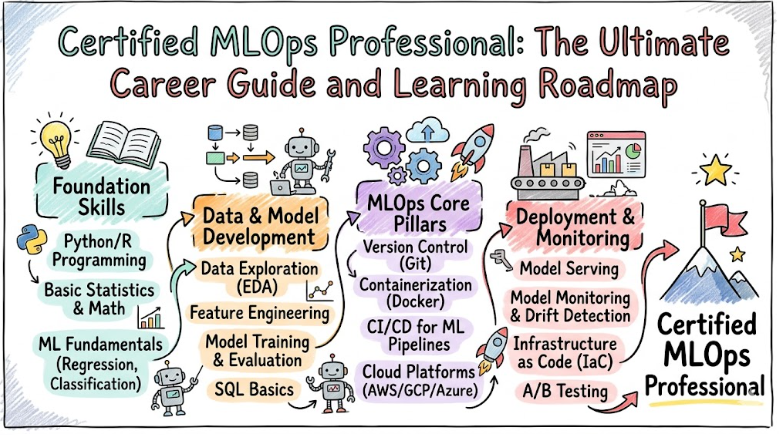
Introduction
The transition from traditional software development to machine learning operations represents one of the most significant shifts in modern engineering. This guide is designed for professionals seeking to master the Certified MLOps Professional designation, a credential that bridges the gap between data science and production engineering. Whether you are a DevOps engineer looking to pivot or a data scientist aiming to operationalize models, understanding this ecosystem is vital.
As organizations move beyond experimental AI, the need for robust, scalable, and automated machine learning pipelines has skyrocketed. This certification, hosted on AIOps School, provides a structured framework for mastering these complex workflows. This guide will walk you through the technical requirements, the career impact, and the practical steps needed to succeed in the evolving landscape of platform engineering and cloud-native deployments.
What is the Certified MLOps Professional?
The Certified MLOps Professional program is a rigorous validation of an engineer’s ability to design, implement, and manage machine learning lifecycles in production environments. Unlike theoretical courses that focus purely on model architecture, this certification emphasizes the “Ops” in MLOps. It covers the essential intersection of CI/CD, data engineering, and automated monitoring, ensuring that machine learning models are not just accurate but also reliable and scalable.
In the current enterprise landscape, manual model deployment is no longer sustainable. This certification represents a commitment to modern engineering standards, including automated retraining, version control for data, and model governance. It exists to standardize the skills required to maintain high-availability ML systems, aligning with the practices used by top-tier technology firms and global enterprises.
Who Should Pursue Certified MLOps Professional?
This certification is specifically designed for technical professionals who sit at the intersection of data and operations. DevOps engineers, Site Reliability Engineers (SREs), and Platform Engineers will find it particularly beneficial as they are increasingly tasked with managing ML infrastructure. By pursuing this path, these professionals can expand their utility within their organizations, moving from general cloud management to specialized AI infrastructure oversight.
Data scientists and machine learning engineers who want to take ownership of their models beyond the Jupyter Notebook stage should also consider this credential. Furthermore, engineering managers and technical architects in both the Indian market and the global sector can use this certification to better understand the complexities of the ML lifecycle. It provides the common language needed for cross-functional teams to collaborate effectively on production-grade AI projects.
Why Certified MLOps Professional is Valuable and Beyond
The demand for MLOps expertise is driven by the fact that most machine learning projects fail during the transition from development to production. Organizations are heavily investing in professionals who can prevent these failures by implementing robust operational frameworks. Obtaining this certification ensures that your skills remain relevant as companies shift from “AI-curious” to “AI-first” in their business strategies.
Long-term career longevity in the tech industry requires moving toward specialized roles that are difficult to automate. MLOps is one such field, as it requires a nuanced understanding of both infrastructure and data behavior. By mastering the Certified MLOps Professional curriculum, you demonstrate to employers that you can deliver a high return on investment by reducing the time-to-market for machine learning features while maintaining system stability.
Certified MLOps Professional Certification Overview
The program is delivered via the official platform and is hosted on AIOps School, which serves as a specialized hub for artificial intelligence and operations learning. The assessment approach is designed to be practical, moving away from simple multiple-choice questions toward scenario-based evaluations. This ensures that a certified professional is capable of handling real-world architectural challenges rather than just memorizing definitions.
The ownership and structure of the certification are maintained by industry experts who update the curriculum to reflect current best practices in the cloud-native ecosystem. It covers a broad spectrum of tools and methodologies, focusing on vendor-neutral principles that can be applied to AWS, Azure, GCP, or on-premises environments. The program is structured into logical levels, allowing learners to build their expertise incrementally from foundational concepts to expert-level orchestration.
Certified MLOps Professional Certification Tracks & Levels
The certification is organized into three distinct levels: Foundation, Professional, and Advanced. The Foundation level introduces the core vocabulary and the basic components of an ML pipeline, making it ideal for those new to the field. The Professional level dives deep into implementation details, such as building CI/CD pipelines for ML and managing feature stores. This level is where most active practitioners find the highest immediate value.
The Advanced level is reserved for those who wish to specialize in complex areas such as MLOps for large-scale distributed systems, security in ML (MLSecOps), and cost optimization. These tracks allow professionals to align their certification journey with their specific career goals, whether that is staying in a hands-on engineering role or moving into technical leadership. Each level is designed to build upon the last, creating a clear roadmap for professional development over several years.
Complete Certified MLOps Professional Certification Table
| Track | Level | Who it’s for | Prerequisites | Skills Covered | Recommended Order |
| Core MLOps | Foundation | Beginners, Managers | Basic IT / Cloud | Lifecycle basics, Terminology | 1 |
| Engineering | Professional | DevOps / ML Engineers | Foundation / Python | CI/CD, Pipelines, Monitoring | 2 |
| Architecture | Advanced | Senior Engineers / SREs | Professional Level | Scaling, Security, Governance | 3 |
| Specialized | Expert | Architects / Leads | Advanced Level | Multi-cloud ML, Edge MLOps | 4 |
Detailed Guide for Each Certified MLOps Professional Certification
Certified MLOps Professional – Foundation
What it is
This certification validates a candidate’s understanding of the fundamental principles of machine learning operations. It serves as an entry point into the ecosystem, ensuring the learner understands why MLOps is necessary for the modern enterprise.
Who should take it
It is suitable for junior engineers, project managers, and traditional DevOps professionals who are just beginning their journey into AI-driven infrastructure. It requires no prior ML experience.
Skills you’ll gain
- Understanding the ML lifecycle (CRISP-DM vs. DevOps).
- Basic knowledge of data versioning and model tracking.
- Familiarity with MLOps terminology and core tool categories.
- Knowledge of the differences between traditional software and ML systems.
Real-world projects you should be able to do
- Documenting an MLOps workflow for a small team.
- Identifying bottlenecks in a manual machine learning process.
- Setting up basic versioning for a small dataset.
Preparation plan
- 7–14 days: Review official documentation and core definitions.
- 30 days: Complete a foundational course and pass practice quizzes.
- 60 days: Not usually required for this level unless starting from zero technical background.
Common mistakes
- Overcomplicating the technical requirements.
- Ignoring the cultural shift required for MLOps.
- Focusing too much on specific tools instead of general principles.
Best next certification after this
- Same-track option: Certified MLOps Professional – Professional level.
- Cross-track option: Certified DataOps Professional.
- Leadership option: AI Strategy for Managers.
Certified MLOps Professional – Professional
What it is
This certification validates the ability to implement and automate machine learning pipelines. It focuses on the practical application of CI/CD/CT (Continuous Testing) and the integration of disparate ML tools into a cohesive system.
Who should take it
This is designed for practicing DevOps engineers, machine learning engineers, and data engineers with at least one year of experience in cloud or data environments.
Skills you’ll gain
- Building automated CI/CD pipelines for machine learning.
- Implementing model monitoring and alerting systems.
- Managing feature stores and data pipelines at scale.
- Automating model retraining and deployment strategies (Canary, Blue/Green).
Real-world projects you should be able to do
- Create a full GitHub Actions or Jenkins pipeline for an ML model.
- Deploy a model using Kubernetes and Seldon Core or BentoML.
- Setup Prometheus and Grafana dashboards for model drift detection.
Preparation plan
- 7–14 days: Intensive lab sessions focusing on pipeline automation.
- 30 days: Deep dive into containerization (Docker/K8s) and ML tracking tools (MLflow).
- 60 days: Build a portfolio project that covers the end-to-end lifecycle.
Common mistakes
- Neglecting the data engineering aspect of the pipeline.
- Failing to account for model “drift” in the monitoring strategy.
- Treating ML code exactly like standard application code.
Best next certification after this
- Same-track option: Certified MLOps Professional – Advanced level.
- Cross-track option: Certified DevSecOps Professional.
- Leadership option: Principal MLOps Architect Path.
Certified MLOps Professional – Advanced
What it is
The Advanced certification is a high-level credential for those who design enterprise-grade machine learning platforms. It focuses on architecture, governance, and the optimization of large-scale ML deployments.
Who should take it
This is intended for senior engineers, technical leads, and solutions architects who are responsible for the overall strategy of an organization’s AI infrastructure.
Skills you’ll gain
- Designing multi-tenant ML platforms for large organizations.
- Implementing security and compliance (MLSecOps) for sensitive data.
- Advanced cost optimization and FinOps for ML workloads.
- Orchestrating distributed training and high-scale inference.
Real-world projects you should be able to do
- Architect a global, multi-region ML deployment strategy.
- Implement a centralized governance and audit trail for all models.
- Optimize cloud spend for GPU-intensive training clusters.
Preparation plan
- 7–14 days: Focus on high-level architectural patterns and case studies.
- 30 days: Researching complex compliance frameworks (GDPR/AI Act) in ML.
- 60 days: Comprehensive review of enterprise toolchains and cost management.
Common mistakes
- Focusing on engineering at the expense of business value and compliance.
- Underestimating the cost of data egress and GPU compute.
- Building over-engineered solutions that are too difficult for teams to use.
Best next certification after this
- Same-track option: Expert level Specializations.
- Cross-track option: Certified FinOps Professional.
- Leadership option: CTO or Head of Infrastructure programs.
Choose Your Learning Path
DevOps Path
The DevOps path focuses on applying traditional software delivery principles to machine learning. Professionals in this path will learn how to adapt CI/CD tools to handle data artifacts and model weights. The goal is to create a seamless flow between the data science team and the production environment. This path is essential for organizations looking to reduce the friction of model deployment.
DevSecOps Path
The DevSecOps path emphasizes the security of the machine learning pipeline. This includes securing the data supply chain, protecting model endpoints from adversarial attacks, and ensuring that training environments are compliant with industry regulations. As AI becomes more prevalent, the security of these systems is a top priority for enterprise leaders. Professionals here focus on building “security-by-design” into the ML lifecycle.
SRE Path
The Site Reliability Engineering (SRE) path focuses on the availability and performance of ML models in production. SREs in this space work on ensuring that model inference is low-latency and that the infrastructure can scale to meet demand. They are responsible for setting Service Level Objectives (SLOs) for ML systems and managing the incident response process when models fail or drift. This path bridges the gap between high-scale infrastructure and data science.
AIOps Path
The AIOps path is distinct from MLOps as it focuses on using artificial intelligence to improve traditional IT operations. Professionals in this path learn how to implement ML models to detect anomalies in logs, predict system failures, and automate incident resolution. This is about applying “AI for Ops” rather than “Ops for AI.” It is a vital path for those managing massive, complex cloud environments.
MLOps Path
The MLOps path is the primary focus for those looking to operationalize machine learning. It covers the entire lifecycle from data ingestion to model decommissioning. Professionals on this path gain deep expertise in tools like MLflow, Kubeflow, and specialized cloud services. This is the most direct path for those who want to be titled as MLOps Engineers.
DataOps Path
The DataOps path focuses on the “Data” part of machine learning. Without high-quality, reliable data, machine learning models cannot function. This path covers data versioning, automated data quality checks, and the construction of scalable data pipelines. It ensures that the input for the MLOps pipeline is consistent and trustworthy, which is a foundational requirement for any AI initiative.
FinOps Path
The FinOps path for MLOps is becoming increasingly important as the cost of training and running ML models grows. This path focuses on visibility and optimization of cloud costs associated with GPUs and large-scale storage. Professionals learn how to attribute costs to specific models or teams and how to implement architectural changes that reduce waste. It is a business-critical path for organizations scaling their AI efforts.
Role → Recommended Certified MLOps Professional Certifications
| Role | Recommended Certifications |
| DevOps Engineer | MLOps Foundation, MLOps Professional |
| SRE | MLOps Professional, MLOps Advanced |
| Platform Engineer | MLOps Professional, MLOps Advanced |
| Cloud Engineer | MLOps Foundation, Cloud-Specific MLOps |
| Security Engineer | MLOps Foundation, DevSecOps Professional |
| Data Engineer | DataOps Foundation, MLOps Professional |
| FinOps Practitioner | MLOps Foundation, FinOps Professional |
| Engineering Manager | MLOps Foundation, AI Strategy |
Next Certifications to Take After Certified MLOps Professional
Same Track Progression
Once you have completed the Certified MLOps Professional levels, you should look toward deep specialization. This might include certifications in specific toolchains such as Kubernetes or specialized cloud AI platforms like SageMaker or Vertex AI. Deepening your expertise ensures you remain the go-to person for complex architectural decisions within the machine learning domain.
Cross-Track Expansion
The most successful engineers are those who understand the adjacent domains. After MLOps, moving into DevSecOps or DataOps provides a holistic view of the engineering ecosystem. Understanding how security impacts the ML pipeline or how data quality affects model output makes you a significantly more valuable asset to any technical team.
Leadership & Management Track
For those looking to move out of daily hands-on engineering, transitioning into technical leadership or product management is a viable next step. Certifications in AI strategy, engineering leadership, or FinOps can help bridge the gap. These credentials focus on the “why” and “how much” rather than just the “how,” preparing you for roles like VP of Engineering or Head of AI.
Training & Certification Support Providers for Certified MLOps Professional
DevOpsSchool
DevOpsSchool is a prominent training provider that has established a strong reputation in the technical education space. They offer a wide range of programs focusing on modern engineering practices, including extensive MLOps modules. Their curriculum is known for being comprehensive and hands-on, providing students with access to real-world lab environments. They cater to both individual learners and corporate teams, ensuring that the training is aligned with current industry requirements. With a large community of alumni and expert instructors, DevOpsSchool provides a robust support system for those looking to master MLOps and other related disciplines in the DevOps ecosystem.
Cotocus
Cotocus operates at the intersection of technical consultancy and professional training, offering a unique perspective on the MLOps lifecycle. Their training programs are often informed by the real-world consulting projects they undertake for global clients. This ensures that the learning material is not just theoretical but grounded in practical, production-grade challenges. Cotocus focuses on high-end niche technologies and offers tailored training solutions for enterprises. Their approach to MLOps training emphasizes the integration of various cloud-native tools to create a cohesive operational environment, making them a preferred choice for organizations looking to upskill their engineering staff.
Scmgalaxy
Scmgalaxy has long been a community-driven hub for software configuration management and DevOps enthusiasts. Over the years, it has evolved into a significant training provider that covers the entire spectrum of modern operations, including MLOps. Their training methodology is deeply rooted in tool-based mastery and best practices. Scmgalaxy provides an extensive library of resources, tutorials, and certification guides that are highly valued by professionals. Their MLOps training focuses on the practical use of automation tools and CI/CD frameworks, helping engineers bridge the gap between development and operations through clear, well-structured educational content.
BestDevOps
BestDevOps focuses on delivering streamlined and effective training paths for busy professionals. Their MLOps certification support is designed to get engineers up to speed quickly without sacrificing depth. They offer a variety of learning formats, including self-paced and instructor-led sessions, tailored to different learning styles. The curriculum at BestDevOps is frequently updated to keep pace with the rapid changes in the AI and ML toolchains. By focusing on the most relevant skills and tools, they help candidates achieve their certification goals efficiently, making it an excellent choice for those looking for a practical and result-oriented learning experience.
devsecopsschool.com
DevSecOpsSchool.com is a specialized training platform that focuses exclusively on the integration of security into the modern software development lifecycle. Their MLOps offerings are unique because they approach machine learning operations through a security lens. They teach students how to secure data pipelines, protect models from attacks, and ensure compliance across the ML lifecycle. This specialized focus is increasingly important as enterprises face growing threats to their AI systems. The school provides detailed labs and scenarios that simulate security breaches in ML environments, preparing professionals to build resilient and secure MLOps frameworks in a high-stakes corporate world.
sreschool.com
SRESchool.com focuses on the principles of Site Reliability Engineering and how they apply to modern distributed systems, including machine learning platforms. Their training programs emphasize observability, reliability, and scalability—the core pillars of a successful MLOps implementation. By teaching students how to apply SRE concepts like error budgets and SLIs to ML models, they provide a framework for maintaining high-performing AI systems. The school is known for its technical rigor and its focus on production-grade stability. Professionals who train here learn how to move beyond simple automation to create truly robust and self-healing machine learning infrastructures.
aiopsschool.com
AIOpsSchool.com is the primary hosting platform for the Certified MLOps Professional credential and serves as a specialized center for AI-driven operations. Their training programs are designed by industry veterans who are actively working on scaling AI in production. The curriculum at AIOpsSchool is holistic, covering both the technical and strategic aspects of MLOps and AIOps. They provide a high-quality learning environment with state-of-the-art labs and a focus on vendor-neutral principles. As the central authority for this certification, they offer the most direct and comprehensive path for professionals looking to establish themselves as leaders in the AI operations space.
dataopsschool.com
DataOpsSchool.com addresses the critical need for better data management within the machine learning and analytics lifecycle. Their training programs focus on creating automated, reproducible, and high-quality data pipelines that serve as the foundation for all MLOps activities. Students learn about data versioning, automated testing for data, and the orchestration of complex data flows. By focusing on the “DataOps” aspect, this school helps engineers solve the data bottlenecks that often stall machine learning projects. Their curriculum is essential for anyone who wants to ensure that their MLOps pipeline is fueled by reliable and consistent data streams.
finopsschool.com
FinOpsSchool.com specializes in the financial management of cloud environments, a discipline that is becoming vital as AI compute costs soar. Their MLOps-related training focuses on the cost-optimization of machine learning workloads, including GPU management and storage efficiency. Professionals learn how to implement cost-allocation tags, monitor spend in real-time, and architect models for maximum cost-efficiency. This training is particularly valuable for senior engineers and managers who need to justify the ROI of their AI initiatives. FinOpsSchool provides the tools and frameworks necessary to balance high-performance machine learning with fiscal responsibility in a cloud-first world.
Frequently Asked Questions (General)
- How difficult is the Certified MLOps Professional exam?
The exam is moderately difficult and requires a solid understanding of both DevOps and ML principles. It is not just about theory; you must understand how tools interact in a production environment. - How much time does it take to prepare for the certification?
For most professionals with an engineering background, 30 to 60 days of consistent study and hands-on practice is sufficient to clear the professional level. - Are there any prerequisites for the foundation level?
There are no formal prerequisites, though a basic understanding of cloud computing and the software development lifecycle is highly recommended for success. - Is this certification recognized globally?
Yes, the certification is recognized by global enterprises and startups as a valid measure of an engineer’s ability to manage machine learning operations. - Does the certification expire?
Most certifications in this field are valid for two to three years, after which you may need to recertify or move to a higher level to stay current. - What is the return on investment for this program?
Certified professionals often see significant salary increases and gain access to high-demand roles in AI-first companies, making the time and cost investment very favorable. - Do I need to know how to code in Python?
Yes, at least a foundational knowledge of Python is necessary, as it is the primary language used for machine learning and many automation scripts. - Can I take the exam online?
Yes, the certification exams are typically offered through an online proctored format, allowing you to take them from anywhere in the world. - Is hands-on experience required?
While not strictly required for the foundation level, hands-on experience is essential for the professional and advanced levels to pass the practical assessments. - How does this differ from a standard DevOps certification?
This certification focuses specifically on the challenges of machine learning, such as data drift, model retraining, and specialized hardware like GPUs, which are not covered in standard DevOps. - Are there any community groups for students?
Yes, platforms like AIOps School and Scmgalaxy offer forums and community groups where students can share knowledge and ask questions during their preparation. - What tools are covered in the curriculum?
The curriculum is vendor-neutral but covers popular industry tools like MLflow, Kubeflow, Docker, Kubernetes, and various cloud-native AI services.
FAQs on Certified MLOps Professional
- What specifically makes this certification “Professional” grade?
It moves beyond basic definitions and requires candidates to demonstrate how they would solve complex, real-world deployment and monitoring problems in a live environment. - Does this certification cover both AIOps and MLOps?
While the focus is primarily on MLOps, it covers the foundational intersection where AI is used to improve operations, providing a well-rounded view of AI in the enterprise. - Is there a heavy focus on math or statistics?
No, the focus is on the operational side. You need to understand what a model does and how it behaves, but you won’t be required to derive complex mathematical formulas. - How often is the course content updated?
The content is reviewed and updated regularly to reflect the latest tools, security practices, and architectural patterns in the fast-moving AI industry. - Can this help me pivot from a traditional DBA role to DataOps?
Absolutely. It provides the necessary bridge between static data management and the dynamic data requirements of machine learning and modern analytics. - Are there lab environments provided during the training?
Most authorized training providers like AIOps School provide sandboxed cloud environments where you can practice setting up pipelines and monitoring systems. - What is the pass mark for the certification?
The pass mark varies by level but generally requires a score of 70% or higher to demonstrate a professional level of competency. - Is this certification suitable for freelance consultants?
Yes, it provides a credible way for freelancers to prove their expertise to clients looking for specialized MLOps and AI infrastructure skills.
Final Thoughts: Is Certified MLOps Professional Worth It?
As a mentor who has seen many technology waves, I can confidently say that MLOps is not a passing trend. It is the natural evolution of software engineering in an era where data is the primary driver of business value. If you are looking to future-proof your career, the Certified MLOps Professional path is one of the most strategic investments you can make. It demonstrates that you are not just a tool-user, but an architect of the systems that will define the next decade of technology.
However, remember that a certification is only as valuable as the effort you put into the practical application of its principles. Use this program as a roadmap, but supplement it with your own projects, experiments, and real-world problem-solving. In the end, the goal is not just to have a certificate on your wall, but to have the confidence and skill set to lead high-impact AI initiatives in any organization. For those willing to put in the work, the career rewards are substantial and long-lasting.

Find Trusted Cardiac Hospitals
Compare heart hospitals by city and services — all in one place.
Explore Hospitals
This is a clear and well-structured guide that explains the MLOps career path, key skills, and certification tracks in a practical way, making it easier to understand how to grow in this field.