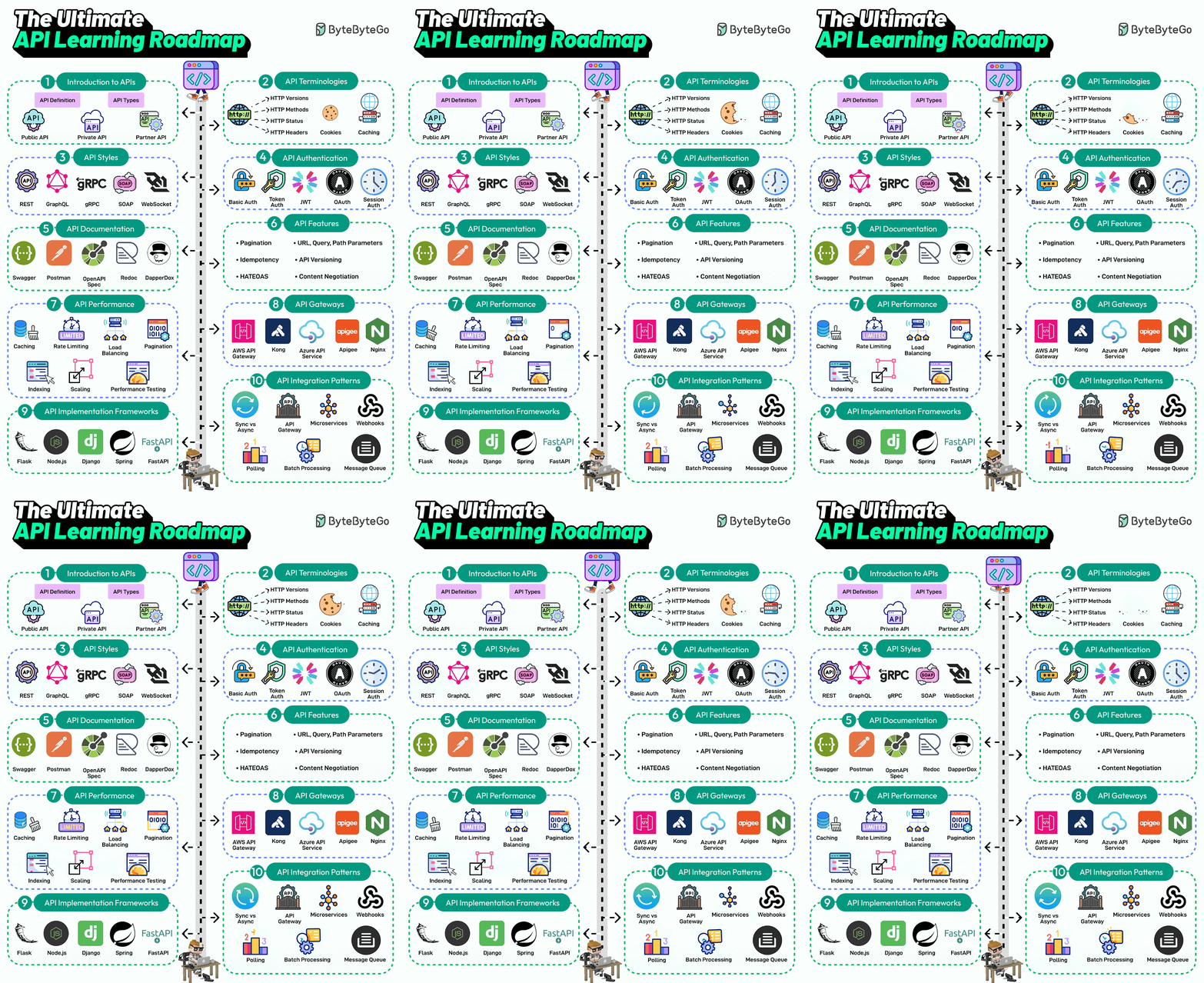
🔹 What is API Architecture?
✅ API Architecture defines how APIs are designed, structured, and implemented to enable seamless communication between applications, services, and systems.
✅ It involves defining protocols, data formats, security mechanisms, scalability strategies, and performance optimizations to ensure efficient API interactions.
📌 Example:
- A banking system uses API architecture to allow different apps (mobile banking, ATMs, web banking) to securely access user account data.
- An e-commerce platform uses API architecture to connect the front-end website, inventory management system, and payment gateways.
🔹 How API Architecture Helps?
✅ 1️⃣ Enables Application Communication → Allows different software systems to communicate efficiently.
✅ 2️⃣ Improves Scalability → Supports horizontal scaling and load balancing for handling high traffic.
✅ 3️⃣ Enhances Security → Implements authentication (OAuth, JWT, API Keys) and encryption (TLS, SSL).
✅ 4️⃣ Enables API Reusability → APIs can be reused across multiple applications to speed up development.
✅ 5️⃣ Reduces Development Time → Microservices and API-first design help developers build faster.
✅ 6️⃣ Supports Multiple Clients & Devices → APIs power mobile apps, web apps, IoT, AI, and third-party integrations.
✅ 7️⃣ Improves Performance → Supports caching, rate limiting, and pagination for optimal speed.
✅ 8️⃣ Facilitates Automation & DevOps → APIs allow CI/CD pipelines, cloud automation, and infrastructure as code (IaC).
🔹 List of API Architecture Styles
Different API architectures define how APIs are structured, interact, and communicate with clients. Below are the major API architecture styles:
1️⃣ REST (Representational State Transfer)
✅ Description:
- Follows stateless HTTP-based communication using standard HTTP methods (
GET,POST,PUT,DELETE). - Uses JSON or XML for data exchange.
✅ Best For:
- Web & mobile applications
- Cloud services (AWS, Google Cloud APIs)
- Microservices architecture
✅ Examples:
- GitHub REST API, Twitter API, Google Maps API
📌 Pros:
✔ Simplicity & scalability
✔ Caching & statelessness improve performance
✔ Works well over HTTP
📌 Cons:
❌ Over-fetching/under-fetching of data (no custom queries like GraphQL)
❌ No built-in real-time communication
2️⃣ SOAP (Simple Object Access Protocol)
✅ Description:
- Uses XML-based messaging with strict standards (WSDL, UDDI).
- Supports stateful and stateless communication.
- More complex than REST but highly secure & reliable.
✅ Best For:
- Enterprise applications (banking, insurance, healthcare)
- Financial transactions & security-sensitive APIs
✅ Examples:
- PayPal API, Banking APIs, Government Data APIs
📌 Pros:
✔ High security & reliability
✔ Supports ACID transactions
✔ Works with multiple protocols (HTTP, SMTP, TCP)
📌 Cons:
❌ Slower than REST
❌ Requires XML, making it less developer-friendly
3️⃣ GraphQL
✅ Description:
- Clients specify exactly what data they need, preventing over-fetching & under-fetching.
- Uses a single endpoint for all queries.
✅ Best For:
- Applications needing dynamic and complex data fetching
- Microservices & real-time apps
- Frontend-heavy applications (React, Angular, Vue.js)
✅ Examples:
- GitHub GraphQL API, Shopify API, Facebook API
📌 Pros:
✔ Optimized queries reduce bandwidth usage
✔ Fetch multiple resources in a single request
✔ Strongly typed schema
📌 Cons:
❌ More complex than REST
❌ Caching is harder to implement
4️⃣ gRPC (Google Remote Procedure Call)
✅ Description:
- Uses Protocol Buffers (Protobuf) instead of JSON, making it faster & efficient.
- Supports bidirectional streaming (real-time communication).
✅ Best For:
- High-performance, low-latency applications
- Microservices & distributed systems
- IoT & AI/ML applications
✅ Examples:
- Kubernetes API, Netflix API, Google Cloud APIs
📌 Pros:
✔ Faster than REST & GraphQL
✔ Supports real-time streaming
✔ Ideal for inter-service communication
📌 Cons:
❌ More complex to set up than REST
❌ Requires client SDKs for communication
5️⃣ WebSockets API
✅ Description:
- Provides persistent two-way communication between client & server.
- Used for real-time applications where instant updates are needed.
✅ Best For:
- Live chat applications (WhatsApp, Slack, Discord)
- Stock market, sports updates
- Multiplayer gaming
✅ Examples:
- Binance API (crypto trading WebSockets)
- Slack WebSockets API
📌 Pros:
✔ Low latency (instant updates)
✔ Persistent connection reduces overhead
📌 Cons:
❌ Not ideal for traditional request-response APIs
6️⃣ RESTful Webhooks
✅ Description:
- Allows event-driven architecture where APIs notify clients when events occur.
- Instead of polling, webhooks push updates automatically.
✅ Best For:
- Payment confirmations (PayPal, Stripe Webhooks)
- CI/CD pipeline triggers (GitHub Webhooks)
- Order & shipment updates
✅ Examples:
- Stripe Webhooks, GitHub Webhooks, Slack Incoming Webhooks
📌 Pros:
✔ Real-time event-driven execution
✔ Reduces unnecessary API calls (no polling)
📌 Cons:
❌ Harder to debug
❌ Requires webhook security measures
7️⃣ RPC (Remote Procedure Call)
✅ Description:
- Allows direct function calls between applications over a network.
- Older APIs like XML-RPC, JSON-RPC use this architecture.
✅ Best For:
- Legacy systems & remote function execution
- Performance-sensitive microservices
✅ Examples:
- Ethereum JSON-RPC API, Amazon XML-RPC API
📌 Pros:
✔ Faster than REST in some cases
✔ Efficient for microservices
📌 Cons:
❌ More complex than REST
❌ Less flexible than GraphQL or gRPC
🔹 Final Summary: Which API Architecture Should You Choose?
| Use Case | Best API Architecture |
|---|---|
| Web & Mobile Applications | REST, GraphQL |
| Enterprise & Banking Apps | SOAP |
| Microservices Communication | gRPC, GraphQL |
| Real-Time Streaming (Chat, IoT, Stocks, Sports) | WebSockets, gRPC |
| Event-Driven APIs (Payments, CI/CD, Notifications) | Webhooks |
| Legacy System Integration | RPC (XML-RPC, JSON-RPC) |
📌 Final Decision:
- Use REST for general-purpose APIs.
- Use GraphQL for frontend-heavy applications.
- Use gRPC for microservices & real-time high-performance needs.
- Use WebSockets for live updates & messaging.

I’m Rajesh Kumar, a DevOps, SRE, DevSecOps, Cloud, and Platform Engineering expert passionate about sharing practical knowledge, real-world experiences, and industry best practices. I have worked at Cotocus and regularly write about technology, travel, investing, health, product reviews, and digital marketing through my various platforms.
I publish technical articles at DevOps School, travel stories at Holiday Landmark, stock market insights at Stocks Mantra, health and fitness guidance at My Medic Plus, product reviews at TrueReviewNow, and SEO and digital marketing strategies at Wizbrand.
Find Trusted Cardiac Hospitals
Compare heart hospitals by city and services — all in one place.
Explore Hospitals